Showing posts with label listening. Show all posts

Tuesday, June 03, 2008

Pope John XXIII


"Let's get lunch." - Attributed to Pope John XXIII just after his election


Pope John XXIII was born Angela Giuseppe Roncalli, and was sometimes known as Good Pope John. He is a saint in the Roman Church, and Anglicans and Lutherans commemorate him as a reformer of the church.

First, I want to remind folks that Protestantism has developed its own dogma. Sola Scriptura, for example, is just as toxic as the worst Catholic dogmas. As humans are wont to do, Protestants too have fallen into a routine. I suppose the Romans do do dogma a bit more strictly than others, but I don't want us to think that the Romans are all inflexible, and the Protestants aren't.

Still, for many Roman Catholics, Vatican II was indeed a time of great renewal. The Mass could now be celebrated in the vernacular, and ordinary people could understand what was going on. While the Church certainly condemned Communism, and Pope John XXIII excommunicated Fidel Castro, many saw the Church coming to a certain acceptance of some teachings of liberation theology (which stressed Marxist social analyses and was basically Socialist). Vatican II was also seen as promoting increased ecumenical activity. Pope John said that although he wasn't out to change church dogmas, Vatican II would be about preaching Christ's message in light of the changing world.

And that is what Good Pope John offers us: a vision of reform grounded in our core values. Liberal Protestants have always been willing to challenge doctrines that many Christians regard as essential, and challenge is always good.

However, while we must not define ourselves in a way to condemn others, we must hold true to what defines us.

So, while some conservatives may believe in the literal truth of the Scriptures, I prefer to believe that the Scriptures contain everything necessary to salvation. That doesn't mean everything in Scripture is necessary, or that salvation is not to be found elsewhere, but it does mean that Scripture is critical.

And, The Center for Progressive Christianity, in point 1 of its 8 points of Progressive Christianity, maintains that we have found an approach to God through the life and teachings of Jesus. I prefer to believe that for Christians, Jesus is the definitive experience of God.

Christian conservatives in the UK, like Bishop Michael Nazir-Ali, are going on and on about how the UK has lost its core Christian identity, and is allegedly trying to force multiculturalism down everyone's throat. For certain, the UK has become markedly less Christian. It is understandable that Christians might feel a sense of loss. But, instead of wanting a Christian state, can we Christians assert our core sense of Christianity without threatening others?

Globalization and immigration are simple facts of life that Christians must adapt to.

Friday, March 28, 2008

Some perspectives on Rev. Jeremiah Wright

1 If a man divorces his wife
and she goes from him
and becomes another man’s wife,
will he return to her?
Would not such a land be greatly polluted?
You have played the whore with many lovers;
and would you return to me?

says the Lord.

2 Look up to the bare heights, and see!
Where have you not been lain with?
By the waysides you have sat waiting for lovers,
like a nomad in the wilderness.
You have polluted the land
with your whoring and wickedness.

3 Therefore the showers have been withheld,
and the spring rain has not come;
yet you have the forehead of a whore,
you refuse to be ashamed.

4 Have you not just now called to me,
‘My Father, you are the friend of my youth—

5 will he be angry for ever,
will he be indignant to the end?’
This is how you have spoken,
but you have done all the evil that you could

Jeremiah 3:1-5

Jeremiah, the Old Testament prophet, did not mince words. In the above, he references OT-era Israel, and compares his country to a commercial sex worker.

Jeremiah Wright, the UCC pastor formerly associated with Barack Obama's campaign, didn't mince words, either. He condemned the United States for various injustices, as Tim Wise, writing for Counterpunch points out.

Wright said not that the attacks of September 11th were justified, but that they were, in effect, predictable. Deploying the imagery of chickens coming home to roost is not to give thanks for the return of the poultry or to endorse such feathered homecoming as a positive good; rather, it is merely to note two things: first, that what goes around, indeed, comes around--a notion with longstanding theological grounding--and secondly, that the U.S. has indeed engaged in more than enough violence against innocent people to make it just a tad bit hypocritical for us to then evince shock and outrage about an attack on ourselves, as if the latter were unprecedented.

He noted that we killed far more people, far more innocent civilians in Hiroshima and Nagasaki than were killed on 9/11 and "never batted an eye." That this statement is true is inarguable, at least amongst sane people. He is correct on the math, he is correct on the innocence of the dead (neither city was a military target), and he is most definitely correct on the lack of remorse or even self-doubt about the act: sixty-plus years later most Americans still believe those attacks were justified, that they were needed to end the war and "save American lives."

But not only does such a calculus suggest that American lives are inherently worth more than the lives of Japanese civilians (or, one supposes, Vietnamese, Iraqi or Afghan civilians too), but it also ignores the long-declassified documents, and President Truman's own war diaries, all of which indicate clearly that Japan had already signaled its desire to end the war, and that we knew they were going to surrender, even without the dropping of atomic weapons. The conclusion to which these truths then attest is simple, both in its basic veracity and it monstrousness: namely, that in those places we committed premeditated and deliberate mass murder, with no justification whatsoever; and yet for saying that I will receive more hate mail, more hostility, more dismissive and contemptuous responses than will those who suggest that no body count is too high when we're the ones doing the killing. Jeremiah Wright becomes a pariah, because, you see, we much prefer the logic of George Bush the First, who once said that as President he would "never apologize for the United States of America. I don't care what the facts are."

And Wright didn't say blacks should be singing "God Damn America." He was suggesting that blacks owe little moral allegiance to a nation that has treated so many of them for so long as animals, as persons undeserving of dignity and respect, and which even now locks up hundreds of thousands of non-violent offenders (especially for drug possession), even while whites who do the same crimes (and according to the data, when it comes to drugs, more often in fact), are walking around free. His reference to God in that sermon was more about what God will do to such a nation, than it was about what should or shouldn't happen. It was a comment derived from, and fully in keeping with, the black prophetic tradition, and although one can surely disagree with the theology (I do, actually, and don't believe that any God either blesses or condemns nation states for their actions), the statement itself was no call for blacks to turn on America. If anything, it was a demand that America earn the respect of black people, something the evidence and history suggests it has yet to do.


Wise goes on later to argue that:

Most white people desire, or perhaps even require the propagation of lies when it comes to our history. Surely we prefer the lies to anything resembling, even remotely, the truth. Our version of history, of our national past, simply cannot allow for the intrusion of fact into a worldview so thoroughly identified with fiction. But that white version of America is not only extraordinarily incomplete, in that it so favors the white experience to the exclusion of others; it is more than that; it is actually a slap in the face to people of color, a re-injury, a reminder that they are essentially irrelevant, their concerns trivial, their lives unworthy of being taken seriously. In that sense, and what few if any white Americans appear capable of grasping at present, is that "Leave it Beaver" and "Father Knows Best," portray an America so divorced from the reality of the times in which they were produced, as to raise serious questions about the sanity of those who found them so moving, so accurate, so real. These iconographic representations of life in the U.S. are worse than selective, worse than false, they are assaults to the humanity and memory of black people, who were being savagely oppressed even as June Cleaver did housework in heels and laughed about the hilarious hijinks of Beaver and Larry Mondello.

These portraits of America are certifiable evidence of how disconnected white folks were--and to the extent we still love them and view them as representations of the "good old days" to which we wish we could return, still are--from those men and women of color with whom we have long shared a nation. Just two months before "Leave it to Beaver" debuted, proposed civil rights legislation was killed thanks to Strom Thurmond's 24-hour filibuster speech on the floor of the U.S. Senate. One month prior, Arkansas Governor Orville Faubus called out the National Guard to block black students from entering Little Rock Central High; and nine days before America was introduced to the Cleavers, and the comforting image of national life they represented, those black students were finally allowed to enter, amid the screams of enraged, unhinged, viciously bigoted white people, who saw nothing wrong with calling children niggers in front of cameras. That was America of the 1950s: not the sanitized version into which so many escape thanks to the miracle of syndication, which merely allows white people to relive a lie, year after year after year.


Mike Huckabee gives his opinion of Jerry here:

As easy as it is for those of us who are white to look back and say, "That's a terrible statement," I grew up in a very segregated South, and I think that you have to cut some slack. And I'm going to be probably the only conservative in America who's going to say something like this, but I'm just telling you: We've got to cut some slack to people who grew up being called names, being told, "You have to sit in the balcony when you go to the movie. You have to go to the back door to go into the restaurant. And you can't sit out there with everyone else. There's a separate waiting room in the doctor's office. Here's where you sit on the bus." And you know what? Sometimes people do have a chip on their shoulder and resentment. And you have to just say, I probably would too. I probably would too. In fact, I may have had ... more of a chip on my shoulder had it been me.


- Mike Huckabee, offering his perspective on the preaching of Rev. Jeremiah Wright. (Source: MSNBC)

It's often very difficult to get ordinary Americans to listen. Too often, the anti-American card is played. Although I would disagree with him on many issues, Mike has started to listen.

Sunday, November 25, 2007

Dorothy Day


Women have had their own numbered as saints for some time now, only they have too often been saints of what I feel is excessive piety. However, Dorothy Day is a saint by activism, and she stands as the equal of any man among the saints.

"What we do is very little. But it is like the little boy with a few loaves and fishes. Christ took that little and increased it. He will do the rest. What we do is so little we may seem to be constantly failing. But so did He fail. He met with apparent failure on the Cross. But unless the seed fall into the earth and die, there is no harvest. And why must we see results? Our work is to sow. Another generation will be reaping the harvest."
—Dorothy Day


Dorothy Day has been declared a Servant of God, the first step to sainthood. Her actual feast day to be is November 29, but I'm moving her up to today to fit in better with the articles I have for this week. Dorothy Day and Peter Maurin co-founded the Catholic Worker movement, and published a newsletter. That newsletter continues to this day. Peter Maurin, a French, working-class, Catholic activist, outlined the beliefs of Catholic Workers in a brief reproduced below.

1. The Catholic Worker believes
in the gentle personalism
of traditional Catholicism.
2. The Catholic Worker believes
in the personal obligation
of looking after
the needs of our brother.
3. The Catholic Worker believes
in the daily practice
of the Works of Mercy.
4. The Catholic Worker believes
in Houses of Hospitality
for the immediate relief
of those who are in need.
5. The Catholic Worker believes
in the establishment
of Farming Communes
where each one works
according to his ability
and gets according to his need.
6. The Catholic Worker believes
in creating a new society
within the shell of the old
with the philosophy of the new,
which is not a new philosophy
but a very old philosophy,
a philosophy so old
that it looks like new.

Day and Maurin were anarchists. Catholic Worker houses were small, non-hierarchical communities. They showed hospitality to all on the margins of society, including undocumented immigrants. Dorothy later worked with Cesar Chavez and the farm workers' movement. As Dorothy said, "The only way to live in any true security is to live so close to the bottom that when you fall you do not have far to drop, you do not have much to lose."

Trinity Stores' site has an elaboration on Dorothy's life, summarized from the book Praying with Dorothy Day by James Allaire and Rosemary Broughton. They state that at the time of the founding of the Catholic Worker newsletter, in 1933, Catholics had been "criticized for a lack of social and political morality." The teachings and actions of the church were not socially conscious. An emphasis on excessive personal piety has long been one of my main criticisms of Roman Catholicism and conservative Evangelicism.

But the Catholic Worker movement instead turns personal piety into a tool for social activism.

We believe this needed personal and social transformation should be pursued by the means Jesus revealed in His sacrificial love. With Christ as our Exemplar, by prayer and communion with His Body and Blood, we strive for practices of

--Nonviolence. "Blessed are the peacemakers, for they shall be called children of God." (Matt. 5:9) Only through nonviolent action can a personalist revolution come about, one in which one evil will not be replaced simply by another. Thus, we oppose the deliberate taking of human life for any reason, and see every oppression as blasphemy. Jesus taught us to take suffering upon ourselves rather than inflict it upon others, and He calls us to fight against violence with the spiritual weapons of prayer, fasting and noncooperation with evil. Refusal to pay taxes for war, to register for conscription, to comply with any unjust legislation; participation in nonviolent strikes and boycotts, protests or vigils; withdrawal of support for dominant systems, corporate funding or usurious practices are all excellent means to establish peace.

--The works of mercy (as found in Matt. 25:31-46) are at the heart of the Gospel and they are clear mandates for our response to "the least of our brothers and sisters." Houses of hospitality are centers for learning to do the acts of love, so that the poor can receive what is, in justice, theirs, the second coat in our closet, the spare room in our home, a place at our table. Anything beyond what we immediately need belongs to those who go without.

--Manual labor, in a society that rejects it as undignified and inferior. "Besides inducing cooperation, besides overcoming barriers and establishing the spirit of sister and brotherhood (besides just getting things done), manual labor enables us to use our bodies as well as our hands, our minds." (Dorothy Day) The Benedictine motto Ora et Labora reminds us that the work of human hands is a gift for the edification of the world and the glory of God.

--Voluntary poverty. "The mystery of poverty is that by sharing in it, making ourselves poor in giving to others, we increase our knowledge and belief in love." (Dorothy Day) By embracing voluntary poverty, that is, by casting our lot freely with those whose impoverishment is not a choice, we would ask for the grace to abandon ourselves to the love of God. It would put us on the path to incarnate the Church's "preferential option for the poor."


My sisters and brothers, Dorothy Day is calling everyone who seeks to bring about God's kingdom. The United States proclaims that in the political realm, the Church and State are separate. However, it has failed to separate the State and Business. Those two are not separate, and our State too often operates for the benefit of Business.

Frankly, I am very different from Dorothy Day. I am a capitalist and I believe in the free market for some things, perhaps many things. And yet, her example reminds me that the Church is called to be at the service of the "least of these." At God's table, the poor will sit first. The rich will only get a seat if they relinquish their power and humble themselves (Jesus, I might remind you, instead calls on us to sell all we have and give to the poor).

But too often, the Church has failed to condemn both State and Business when they violate human rights, despoil the environment, and propagate bigotry. The Church has forgotten that the early Christians drew on all those at the margins of society. This is a Church that lives on the margins!

And yet, the Church has been colonized, and it has allowed itself to be an agent of colonialism. Look at how often Christian nations have gone on crusades of empire, at how we today despoil the environment to maintain our lifestyles, at how we abuse and exploit immigrants, at how we treat people of color. A colonized Church cannot truly serve God.

Can the Church be decolonized? Can the Church become an agent of decolonization? Dorothy Day calls us back to our roots, to live with and serve those on the margins. Dorothy Day presents with a vision ... a vision of a Church decolonized.

O God, you made us all unique;
one pattern for each life you found.
Where falling short of your design
you see us, free us
till by love we're bound.

O Christ, you summon into life
our timid faith, our hidden skill.
Where trust or talent are untried,
there tend us. Send us
grace to know your will.

O Holy Spirit, breath of life,
our noblest visions you inspire.
Where hearts are cold or minds are dull,
there shake us. Make us
flames of heaven's fire.

To God, in whom we live and move,
we vow our love and loyalty;
and here ascribe all honour, power
and glory, glory
now and endlessly.

John Bell, Iona Community

Tuesday, July 17, 2007

An exposition of the parable of the ficticious ex-homophobe Nigerian archbishop

Yesterday, I parodied the parable of the Good Samaritan.

My priest told us that a scholar believes it likely that Jesus was using the three stock characters joke format that plays a prominent role in humor around the world. There's the priest, who's different from all the other Israelites. There's the Levite, who's also different. If this scholar is correct, the last stock character would normally be an Israelite, who would nonetheless react in a different and humorous way from the other two.

Jesus shakes things up a bit, and casts a Samaritan in the last role. I think he wanted to shock his audience a bit, and get them to think, who really was their neighbor. Given the racial relations between Jews and Samaritans, he probably did.

Down South during World War II, a sergeant gets a telephone call from a woman. "I would love it," she said, "if you could bring five of your soldiers to my house for Thanksgiving dinner."
"Certainly, ma'am," replied the sergeant.
"Just make sure they aren't Jews," said the woman.
"Will do," replied the sergeant. So that Thanksgiving while the woman is baking, the doorbell rings. She opens her door and, to her horror, five black soldiers are standing in front of her.
"Oh, my!" she exclaimed. "There must have been some terrible mistake!"
"Nope," said one of the soldiers. "Sergeant Greenburg never makes mistakes!"


I hypothesized in the tale of the Syro-Phoenecian woman that Jesus, incarnate as a human being, took on all our traits, including our prejudices ... and that, as humans sometimes do, he had an encounter that transformed him. He was forced to reconsider his prejudices. And in doing so, he became more fully human.

And so, there's possibly another element to the Good Samaritan. In Jesus' parable, the audience is clearly Jewish, as is the man who was beaten by robbers. His rescuer was a Samaritan. Upon waking, the Jewish man would have been forced to reexamine his prejudices also.

This was the direction I went with the parable of the ficticious ex-homophobe Nigerian archbishop (the ficticious archbishop, by the way, is Anglican). He had not previously considered the consequences of his condemnation of homosexuality. But now, he sees that his hateful words had incited an attack, the victim of which is lying at his feet. He stands condemned by his previous actions, and he chooses a different path.

Note that this ficticious archbishop doesn't necessarily come to reconsider his opinion on whether homosexuality is right or not. He comes to condemn violence against LGBT people, and to abandon hate speech. Perhaps he still believes that they should be celibate, and he has his church create programs to support those who do choose celibacy. Or perhaps he does come to think that homosexuality is a natural variation in human sexuality.

The point is, upon seeing the consequences of his actions, he comes to give up his need to be right. I once read a book on near-death experiences. Mainstream psychologists will of course be highly skeptical. However, one person described being confronted by a being of light, who showed her all the consequences of her actions that hurt another person. She felt judged, and yet not condemned.

Could this be the sort of judgment that awaits us on the last day?

Monday, July 16, 2007

The parable of the Good Samaritan, retold

Just then a lawyer stood up to test Jesus. "Teacher," he said, "what
must I do to inherit eternal life?"

He said to him, "What is written in the law? What do you read there?"

He answered, "You shall love the Lord your God with all your heart,
and with all your soul, and with all your strength, and with all your
mind; and your neighbor as yourself."

And he said to him, "You have given the right answer; do this, and you
will live."

But wanting to justify himself, he asked Jesus, "And who is my neighbor?"

Jesus replied, "An openly gay man was going down from Jerusalem to
Jericho, and fell into the hands of homophobes, who stripped him, beat
him, and went away, leaving him half dead.

"Now by chance an Anglican priest was going down that road; and when
he saw him, he passed by on the other side.

"So likewise a vestry member, when he came to the place and saw him,
passed by on the other side.

"But a certain Nigerian archbishop with known homophobic views, who
had pressed for legislation in his country criminalizing
homosexuality, while traveling came near him. When he saw the man, he
knew the man was gay.

And yet, he realized that his hateful words towards gay people had
enabled this crime, and that in fact, no one deserved to be
discriminated against because of their sexual orientation or gender
identity.

"He went to him and bandaged his wounds, having poured oil and wine on
them. Then he put him on his own animal, brought him to an inn, and
took care of him. The next day he took out two denarii, gave them to
the innkeeper, and said, 'Take care of him; and when I come back, I
will repay you whatever more you spend.'

And the Nigerian archbishop came to staunchly oppose the
criminalization of homosexuality, and advocated instead for
comprehensive hate crimes and anti-discrimination laws covering sexual
orientation and gender identity.

"Which of these three, do you think, was a neighbor to the man who
fell into the hands of the robbers?'

He said, 'The one who showed him mercy.' Jesus said to him, 'Go and do
likewise.'

Luke 10:25-37, NRSV with some alterations

Wednesday, July 11, 2007

Pope B restates "defects" of other religions

One sabbath he was going through the cornfields; and as they made their way his disciples began to pluck heads of grain. The Pharisees said to him, ‘Look, why are they doing what is not lawful on the sabbath?’ And he said to them, ‘Have you never read what David did when he and his companions were hungry and in need of food? He entered the house of God, when Abiathar was high priest, and ate the bread of the Presence, which it is not lawful for any but the priests to eat, and he gave some to his companions.’ Then he said to them, ‘The sabbath was made for humankind, and not humankind for the sabbath; so the Son of Man is lord even of the sabbath.’ - Mark 2:23-27, NRSV

IHT reports that Pope Benedict:

has restated what he said were the "defects" of Christian faiths other than Roman Catholicism, sparking anger from Protestants who questioned the Vatican's respect for other beliefs.

"It makes us question whether we are indeed praying together for Christian unity," the World Alliance of Reformed Churches, which represents Protestants in more than 100 countries, said in a statement. The Vatican document repeated many of the contentious claims of a document issued in 2000 by the Vatican office on orthodoxy, which Cardinal Joseph Ratzinger headed for more than two decades before being elected pope in 2005.

The document released Tuesday focused largely on the Vatican definition of what constitutes a church, which it defined as being traceable through its bishops to Christ's original apostles. Thus, it said, the world's Orthodox Christians make up a church because of shared history, if "separated" from the "proper" Catholic tradition; Protestants, who split from Catholicism during the Reformation, are considered only "Christian communities."

The document repeated church teaching that the Roman Catholic Church alone is the mediator of salvation, though other beliefs can be its "instrument."

"These separated churches and communities, though we believe they suffer from defects, are deprived neither of significance nor importance in the mystery of salvation," the document read. "In fact the Spirit of Christ has not refrained from using them as instruments of salvation, whose value derives from that fullness of grace and of truth which has been entrusted to the Catholic Church."

It was unclear why the Vatican issued the document now, especially since it largely restated earlier, if contentious, statements of church doctrine. The document from 2000, called "Dominus Iesus," prompted angry reactions from other faiths, which accused the Vatican, and Ratzinger specifically, of being unnecessarily divisive.

The stated purpose of the new document was as a "clarification" of doctrine amid much disagreement among Catholics about the legacy of the Second Vatican Council, a three-year conference that ended in 1965 and changed many church practices.

Last week, Benedict made a similar argument in liberalizing the use of the old Latin Mass, largely set aside since the council endorsed holding Mass in the local languages of the world's billion Catholics.

Critics said the decision could further divide Catholics and raised questions about Benedict's commitment to the changes made during the Second Vatican Council.


The Pharisees in Mark 2 were so sure that their adherence to the letter of the law guaranteed them righteousness. It turns out that they were wrong. People across faiths, cultures, and time have realized that the letter of the law is subordinate to the spirit of the law.

Many individual Roman Catholics lack the delusions of grandeur that the current Pope has. They live in the real world. They live with people who are not Roman Catholic, but who God dwells in nonetheless. Benedict and his Cardinals do not live in the real world.

Someday, God will send someone to the Cardinals to say, "The sabbath was made for humankind, and not humankind for the sabbath."

Saturday, July 07, 2007

The Evangelical Lutheran Church of America's Committee on Appeals is afraid of something

Emily Eastwood, Executive Director, Lutherans Concerned/North America, said of the action by the Committee on Appeals, “We are deeply saddened, angry, and more determined following the artless and callous treatment of Pastor Bradley at the hands of the Committee on Appeals. The decision was delivered by email, no pastoral call was made or human contact given. The Committee actually noted as positive that they limited themselves to the transcripts of the hearing. They never met Pastor Schmeling or the members of St. John’s.


The ELCA's Committee on Appeals is afraid of something.

Are they afraid that they'll catch Rev. Schmeling's homosexuality? It is in fact hard to convert to homosexuality (assuming you are born heterosexual). Some say it's possible, with intensive prayer, to change one's sexual behavior. But it's very hard work to go against your sexual orientation, and the committee members would have to be willing to work very hard at living a gay lifestyle.

So, what are they afraid of?

Perhaps they're afraid they'll meet Brad, and change their minds.

We're afraid of associating with people who are different from us. We see it in the White parents who sued several school districts which were trying to keep their schools integrated. They allow their race to insulate themselves from the needs and realities of those who are not White. And they wish to keep doing so.

We see it in the executives of Exxon Mobil, who fund organizations that cast doubt on the veracity of global warming. They allow their great wealth to insulate them from the needs and realities of others who are not so wealthy, and who live in regions more vulnerable to climate change (albeit, even the US will be vulnerable). And they wish to keep doing so.

We see it in the Roman magisterium, which deliberately insulates themselves from the needs and realities of women by not admitting them to the priesthood. And they wish to keep doing so.

And, of course, the ELCA's Committee on Appeals wishes to keep on insulating itself from the needs and realities of LGBT people. However, their time of reckoning may come a lot sooner than those others I mentioned. The ELCA, at their churchwide assembly in August, may repudiate their previous position on homosexuality. If it does not, then some assembly at a later date will. The arc of the universe bends towards justice. In the long run, the opponents of justice are not going to make it.

Friday, July 06, 2007

News on Rev. Schmeling

From LCNA. Emphasis is mine. I believe that Schmeling's church intends to keep him against ELCA wishes, which could subject them to unknown disciplinary action.

Lutherans Concerned Angry and Determined Following the Removal of Pastor Bradley Schmeling from the ELCA Clergy roster on July 2, 2007

On July 2, 2007, the Evangelical Lutheran Church in America (ELCA) Committee on Appeals (COA) denied his appeal and removed Pastor Bradley Schmeling from the clergy roster of the ELCA.

Pastor Schmeling had been charged in August 2006 for violating the ELCA policy that forbids LGBT rostered leaders from living in committed same gender relationships of mutuality, fidelity and respect. In January 2007, an ELCA Discipline Hearing Committee (DHC) conducted an ecclesiastical trial that concluded nearly unanimously that there was no reason under the constitution of the ELCA for Pastor Schmeling to be punished. In fact, they commended his ministry at St. John’s Lutheran, Atlanta, Georgia. However, feeling bound by the ELCA policy, the DHC removed him from the clergy roster with an effective date of August 15th this year. The COA action changed the effective date to July 2nd.

The DHC also had said the ELCA policy of discrimination might be in violation of the constitution of the ELCA, and suggested two avenues to change the policy: a judicial appeal to the Committee on Appeals, and a legislative remedy through action by regional judicatories called synods, and by the ELCA churchwide assembly, which is the highest legislative body of the church.

Emily Eastwood, Executive Director, Lutherans Concerned/North America, said of the action by the Committee on Appeals, “We are deeply saddened, angry, and more determined following the artless and callous treatment of Pastor Bradley at the hands of the Committee on Appeals. The decision was delivered by email, no pastoral call was made or human contact given. The Committee actually noted as positive that they limited themselves to the transcripts of the hearing. They never met Pastor Schmeling or the members of St. John’s.

“There are no scriptural precedents for such behavior in Christ’s life. Jesus was moved with compassion and broke the religious laws of his age, time and again meeting and embracing outcasts in their contexts. There are others in the Gospels, the Scribes and the Pharisees who, according to Jesus, kept the letter of the law but neglected the weightier matters of justice and mercy. Jesus goes on to say to the Pharisees, “you blind guides, you strain out a gnat and swallow a camel.” Matthew: 23. Pastor Schmeling has been treated by the church like a gnat to be swatted away and forgotten. Christ would not recognize the behavior of the Committee on Appeals, and by default the ELCA in this case, as his own.

“This is what happens when human law becomes an end to itself. The judicial process has proven to be an ecclesiastical dry hole. It started with an unjust, discriminatory policy and decided that it had been rightly and justly executed.

“We now turn to the ELCA churchwide assembly in August seeking the legislative remedy offered by the DHC and confirmed as the only alternative by the COA. The Spirit has moved 22 synods of the ELCA to state in no uncertain terms that the policy of discrimination must be changed. These synods represent a full 40% of the membership of the ELCA. They believe that this matter must come to the floor of the assembly, be debated, and the current policy eliminated leaving a single standard for pastors more fitting to those who follow Christ and Martin Luther.

“The struggle is not over, LGBT Lutherans and their allies both clergy and lay will not relent until justice and mercy prevail.”

Monday, June 18, 2007

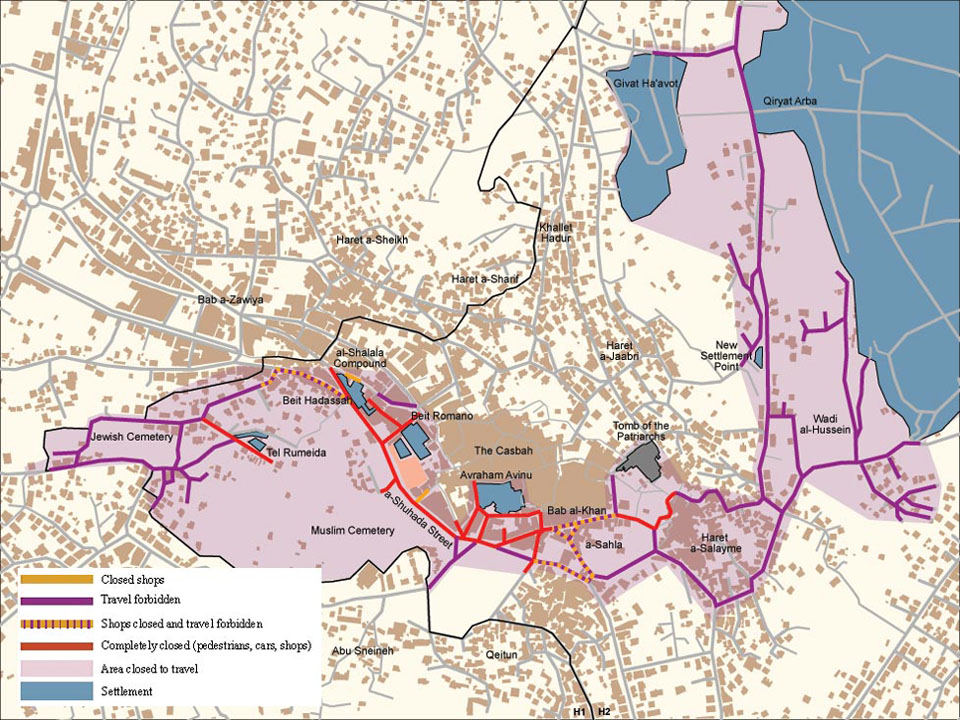
A bit more from our friends at B'Tselem: Israel's Separation Policy and Forced Eviction of Palestinians from the Center of Hebron


Over the years, Israel established a number of settlement points in and around the Old City of Hebron, which had traditionally served as the commercial center for the entire southern West Bank . Israeli law-enforcement authorities and security forces have made the entire Palestinian population pay the price for protecting Israeli settlement in the city. To this end, the authorities impose a regime intentionally and openly based on the "separation principle", as a result of which Israel created legal and physical segregation between the Israeli settlers and the Palestinian majority.

This policy led to the economic collapse of the center of Hebron and drove many Palestinians out of the area. The findings of a survey conducted in preparation of this report show that at least 1,014 Palestinian housing units in the center of Hebron have been vacated by their occupants. This number represents 41.9 percent of the housing units in the relevant area. Sixty-five percent (659) of the empty apartments became vacant during the course of the second intifada. Regarding Palestinian commercial establishments, 1,829 are no longer open for business. This number represents 76.6 percent of all the commercial establishments in the surveyed area. Of the closed businesses, 62.4 percent (1,141) were closed during the second intifada. At least 440 of them closed pursuant to military orders.

The main elements of Israel 's separation policy are the severe and extensive restrictions on Palestinian movement and the authorities' systematic failure to enforce law and order on violent settlers attacking Palestinians. The city's Palestinian residents also suffer as a direct result of the actions of Israel 's security forces.

During the first three years of the intifada, the army imposed a curfew on the Palestinians in the city center of Hebron for more than 377 days total, including a consecutive period of 182 days, with short breaks to obtain provisions.

In addition, the army created a contiguous strip of land in the City Center along which the movement of Palestinian vehicles is forbidden. The middle of the strip contains many sections of road that the army forbids even Palestinian pedestrians to use. The strip blocks the main north-south traffic artery in the city, and therefore affects the entire city. View Map.

The extensive prohibitions have led to the closing of hundreds of shops, in addition to those that were closed under army order.

Failure to protect Palestinians from settler violence

Over the years, settlers in the city have routinely abused the city's Palestinian residents, sometimes using extreme violence. Throughout the second intifada, settlers have committed physical assaults, including beatings, at times with clubs, stone throwing, and hurling of refuse, sand, water, chlorine, and empty bottles. Settlers have destroyed shops and doors, committed thefts, and chopped down fruit trees. Settlers have also been involved in gunfire, attempts to run people over, poisoning of a water well, breaking into homes, spilling of hot liquid on the face of a Palestinian, and the killing of a young Palestinian girl.

Soldiers are generally positioned on every street corner in and near the settlement points, but in most cases they do nothing to protect Palestinians from the settlers' attacks. The police also fail to properly enforce the law, and rarely bring the assailants to justice. By failing to respond appropriately to settler violence in Hebron , the authorities in effect sanction the settlers' violent acts. These acts, in addition to being severe, have also contributed to the "quiet transfer" of thousands of Palestinians from the City Center .

Harm to Palestinian residents by soldiers and police officers

The increased presence of soldiers and police in the Hebron city center brings with it violence, excessive and unjustified use of force, and abuse of the powers granted them by law. Violence, arbitrary house searches, seizure of houses, harassment, detaining passersby, and humiliating treatment have become part of daily reality for Palestinians and have led many of them to move to safer places. In some cases, not even the defense establishment tries to defend the security forces' conduct; however, apparently, not enough has been done to uproot these practices.

* * *

Israel 's policy severely impacts thousands of Palestinians by violating the right to life, liberty, personal safety, freedom of movement, health, and property, among other rights. This policy breaches Israel 's obligations under international humanitarian law, international human rights law, and Israeli administrative and constitutional law. Given the drastic effects of the policy on the fabric of Palestinian life in the area and the resultant "quiet transfer" of thousands of Palestinians, the policy constitutes a breach of the prohibition on forced transfer enshrined in the Fourth Geneva Convention and is therefore a war crime, for which the persons responsible bear personal liability.

The Israeli settlement points in Hebron , which were established in breach of Israel 's obligations under international law, cause severe and continuous breaches of international legal provisions intended to protect the human rights of persons under belligerent occupation. Israel contends that it is impossible to ensure the safety of the settlers without separating Palestinians and Israelis in the city, and without infringing the basic rights of the Palestinian residents, which has resulted in Palestinians leaving the City Center . The State of Israel has the legal and moral obligation to evacuate the Israelis who settled in Hebron , and bring them back to Israel .

Until the settlers are evacuated, the Israeli authorities must ensure their safety while minimizing the violation of the human rights of Palestinians. To accomplish this, the government of Israel must allow Palestinians to move about in the City Center and return to their homes, rejuvenate the City Center as a commercial area, enforce law and order on violent settlers, investigate every case of violation of the law by the security forces, and prevent settlers from taking control of additional buildings and areas in the city.

Full Report, PDF

Tuesday, June 12, 2007

Davis Mac-Iyalla of Changing Attitude Nigeria tells his story

Thanks to Elizabeth Kaeton at Telling Secrets, the Episcopal News Service has an interview with Davis Mac-Iyalla of Changing Attitude Nigeria, the Nigerian branch of a global LGBT organization.

We already knew that Peter Akinola didn't give a shit about human rights, so Davis' accusations against Akinola aren't surprising: that Akinola was afraid of Changing Attitude's growing strength, and wrote the bill to specifically target them, and that he didn't give a shit about the listening process that the Windsor Report called for.

He tells us that it is imperative for the Episcopal Church to publically oppose the likes of Akinola. Too few are doing so.


Nigerian activist tells his story
Mac-Iyalla told the joint INC_NAC that Anglican Church of Nigeria Archbishop and Primate Peter Akinola has been directly involved in Mac-Iyalla called a "deadly bill" pending before the Nigerian legislature that would make homosexuality punishable by five years in prison and would criminalize any association with gay, lesbian, bisexual and transgender people. The bill, he said, "would make us outcasts in our own country."

Mac-Iyalla said Akinola has gone to legislators and government leaders, including Anglicans, and pressured them to write the bill as a way to prevent his organization from gaining any more strength. Changing Attitudes Nigeria has about 2,500 gay, lesbian, bisexual and transgender members, according to Mac-Iyalla. He also suggested that Akinola worked for the bill so that the Listening Process called for by the Windsor Report would be stymied by the government's laws.

It is a lie, he said, for Akinola and others to claim that there are no homosexual people in Nigeria, explaining that many languages spoken in Nigeria had words to describe people in same-gender relationships long before white missionaries came to Africa. Such terms, he said, indicate that Africans have always acknowledged people who are attracted to members of their gender.

"It is wrong to say that homosexuality is a Western, imported culture," Mac-Iyalla said.

Saying that most Nigerians are more worried about eating than they are about homosexuality, Mac-Iyalla said, "the Anglican Church is the only church in Nigeria that has gay-lesbian issues on its agenda."

He asked the Episcopal Church to petition the Nigerian government to oppose the bill and to consult with the Archbishop of Canterbury about speaking against the bill. He also described his group's desire to hold a large meeting of GLBT people in Nigeria after Easter 2008 so that international pressure can be brought to bear on the Nigerian government.

"Our hope is in the Episcopal Church," said Mac-Iyalla, who also described a series of death threats that forced him to flee Nigeria. "If you don't speak out for us, we don't know where we will take our voice."

Wednesday, April 25, 2007

Church of Scotland admits to 'historic intolerance' toward gay people

From a report prepared for their 2007 General Assembly


A working group of the Mission and Discipleship Council is set to present the General Assembly with an in-depth report on ‘same-sex partnerships as an issue in theology and human sexuality’ (Section 4).

The report, which is entitled A challenge to unity, takes as its starting point an acknowledgement of the strength of feeling that has already been expressed on the issue of same-sex relationships. However, the considerable body of work that is to go before May’s Assembly does not seek only to study the two sides of the debate – indeed, the idea that the debate has only two primary viewpoints is specifically rejected. A challenge to unity seeks to give a flavour of the wide range of views held within the church, and to identify areas of common ground around which the church might unite.

Whilst the Legal Questions Committee report to last year’s Assembly approached the question of same-sex partnership from a practical and legal perspective, this year’s report is closely focussed on theological perspectives. As such, the 2007 debate will build upon work arising from the General Assembly of 1994. In that year the former Board of Social Responsibility produced a report on human sexuality, while the then Panel on Doctrine reported on the theology of marriage. At that time, neither of these reports was specifically endorsed by the Assembly, although both were accepted as the basis for further debate. (Sections 4.3.2 – 4.3.8)

As a part of its remit, the working group that produced A challenge to unity listened to gay and lesbian Christians, including two Church of Scotland ministers who have entered into civil partnership with their same-sex partners. These respondents expressed a wide range of perspectives, and the working group has listened to testimonies which have led members to recognise pastorally insensitive – indeed, sinful – attitudes on the part of the Church towards gay people. (Section 4.5.2)

Naturally enough, a considerable part of the working group’s discussion focussed on interpretation of scripture. Some take the view that the only rightful place for human sexual activity is within the realm of heterosexual marriage. By this token, homosexual sexual activity, as well as sex between unmarried heterosexuals, can be seen as contrary to scriptural guidance. Perhaps it could be said that homosexual orientation is a naturally occurring phenomenon, but that homosexual acts should be resisted?

However, there are a number of alternatives to this approach. There are many who would see potential for a gay or lesbian’s sexual life being contained in a marriage-like relationship. Eugene Rogers’ book, Sexuality and the Christian Body, picks up from the note that marriage is a means of redemption: men and women are sanctified through marriage. Marriage is about transforming sexual love into Christian love: from falling in love to living with someone in increasing respect, tenderness and delight. On this basis, Rogers would extend its benefits to gays and lesbians, saying 'The trouble with most conservative accounts is not that in denying same-sex couples the rite of marriage they would deny them true self-satisfaction, although they might. The trouble is that in denying same-sex couples the rite of marriage they would deny them true self-denial.' (Section 4.16.2.7)

The working group on human sexuality has identified a number of questions which the Kirk, and the Christian church as a whole, will have to address during the years ahead. For example, how is God’s creation and providence to be understood? To what extent should our understanding of humanity develop from thought about sinfulness or redemption? Are homosexual acts per se sinful? When is it legitimate to read certain scriptural texts as teaching one thing but to believe that the Holy Spirit is leading the church to set aside that reading? To what extent are faithful gay and lesbian relationships akin to marriages? Is conducting a liturgy for a couple following a civil partnership a matter on which ministers may act? (Section 4.17.6)

The 12 representatives on the working group come from a variety of theological backgrounds and, as a result of this, they have settled upon wide-ranging conclusions. The document set to be debated at May’s General Assembly says that where there is now a strong measure of agreement is on the question of homosexual orientation. Many people are both gay and Christian; having a homosexual orientation is not a matter for censure; having a homosexual orientation does not preclude service to Christ in the church and the world. A homosexual orientation should not be a barrier to any role in church and state, and the Church should oppose all forms of discrimination on these grounds, both in environments where the Church carries authority and in society at large. (Section 4.17.7)

However, there is a continuing difference of opinion on the matter of homosexual sexual activity: Many will respond that the distinction between homosexual orientation and activity is untenable and unfair. For them, traditional prohibitions on homosexual activity must be reconsidered, with a greater weight being given in scriptural interpretation and moral discernment to love, faithfulness, honesty, selflessness and other reflections of God’s incarnate love. But others hold that distinguishing between a morally neutral homosexual orientation and sinful homosexual activity is the scripturally-formed Christian approach to take to these matters. Likewise it would be an interpretation of love, faithfulness, honesty and selflessness. (Section 4.17.8)

In conclusion, the working group’s report upholds in the strongest possible terms the importance of exchange of views between different parties, of listening to the other, and of discerning what measure of unity still matters despite the seriously contentious questions being raised over issues of human sexuality. There is little to be gained, and rather much to be lost, by one set of views being stampeded over, and against the conscience of others.

Thursday, April 12, 2007

Comments and examples on listening as a sacred act

Jesus gave us a wonderful summary of the law in Matthew 22:37-40: He said to him, ‘ “You shall love the Lord your God with all your heart, and with all your soul, and with all your mind.” This is the greatest and first commandment. And a second is like it: “You shall love your neighbour as yourself.” On these two commandments hang all the law and the prophets.’

That's all well and good. But, what if my neighbor is different from me? If I were straight and I didn't know anyone who was gay, I could honestly say, "If I'm gay, I would like to be sent for conversion therapy or to be celibate. I think that's the only loving thing to do." This would be a disaster. And in a multicultural context, this happens a lot, when those in power define the experience of Others for them, diminishing their humanity and forcing them to fight an unequal battle just to be heard.

I'm a nice guy. I want to love my neighbor. But I cannot love my neighbor if I do not know how.

So, I must listen. I must put aside the fears and the prejudices I've learned. I must lose the need to be right about everything. And I must either put on hold the desire to change the people I am listening to, or I must be equally willing to let them change me. I must listen to the Others, as they define their worldview for me, and tell me of their struggles in their own language.

Paradoxically, it was only when I did this that I really started to grow into my faith.

Now, at the Lambeth Conference in 1998, the Anglican Communion instructed all Provinces to begin a listening process, to hear the experience of LGBT people. A link is below.

Link


I would like to highlight the actions of three Provinces. The Anglican Church of Canada is a candidate for gold standard. They say:

"The official process of listening began in 1976 with the bishops commissioning a ‘Task Force’ to assist their thinking on issues of homosexuality. The report was only for bishops and in 1979 the bishops committed themselves to further study and requested the preparation of study materials which were published in 1985.

"The House of Bishops in November 1992 reported on their process of further study which had been based on the Church of England booklet Some Issues in Human Sexuality. The study moved beyond this report and the following sentence in their report is illuminating:

"A year earlier, we had suggested that bishops should seek opportunities in their own situations to engage in dialogue with members of the homosexual community. From the nature of our discussions, it was clear that many had done so.
The process had moved from “study about” to “dialogue with” homosexual people.

"It was clear at the time that a serious engagement with the Scriptures was needed. The study process was also to include ‘the experience of gays and lesbians who are committed Christians’.

"As a result the 1997 Statement by the Anglican Bishops included the following paragraph:

"We are thankful to see a new sensitivity emerging towards gay and lesbian persons in the Church. No longer can we talk in the abstract. We are experiencing a growing awareness that the persons of whom we speak are among us. They are our sons and daughters. They are our friends and relatives."

The Others become one of Us. That does not mean that the entire ACC completely accepts everything that LGBT people say and do:
"It is well publicised that the Diocese of New Westminster authorised a service of blessing for same sex couples, but this is not the policy of the Church. The Anglican Church of Canada is divided over the issues of the blessing of same sex relationships and of the ordination of clergy in same sex relationships. It remains the official policy of the church not to accept the blessing of homosexual unions and individual dioceses do not have national sanction to authorise such blessings in their dioceses. However, the General Synod of 2004 requested that the Faith, Worship and Ministry Committee “prepare resources for the church to use in addressing issues relating to human sexuality, including the blessing of same sex unions and the changing definition of marriage in society.”"

But that's OK, I think. There are safe spaces in the Church of Canada for LGBT people. Liberals, moderates and conservatives are in dialog and are listening.

However, the report from the Church of Nigeria (Anglican Communion) is not so positive. Reading their report makes it clear that they are not listening. They are lecturing. They open with:

"The Church of Nigeria (Anglican Communion) is a bible-based and spiritually dynamic Church that seeks to epitomise the genuine love of Christ. The Church’s attitude to homosexuality is rooted in biblical values and pre-supposed by a high view of Scripture.

"The Primate of all Nigeria has said “Our argument is that, if homosexuals see themselves as deviants who have gone astray, the Christian spirit would plead for patience and prayers to make room for their repentance. When scripture says something is wrong and some people say that it is right, such people make God a liar. We argue that it is a blatant lie against Almighty God that homosexuality is their God-given urge and inclination. For us, it is better seen as an acquired aberration.”

"The Church of Nigeria sees its view as based upon the witness of Scripture. The House of Bishops issued a detailed and clearly argued statement. In it there are discussed four texts from the Old Testament which speak specifically of homosexual acts. These are Genesis 19:5, Leviticus 18:22, Leviticus 18:27 and Judges 19:22. All these texts show how homosexuality is regarded as an abominable deed. The statement concludes: “Thus it is clear from the passages considered that the Old Testament regards homosexuality as an atrocious and unnatural act. The Mosaic Law is against it and stipulates capital punishment for the offender. It is classified among the most offensive crimes like idolatry involving the sacrifice of children, having intercourse with animals, or marrying a woman and her mother.”"

Interestingly, they also say this: "In Nigerian traditional culture homosexuality is seen as taboo. Homosexuals are thought of as threatening the divinely ordained order of the community. The Western idea of human rights is subservient to the service of the common good."

In many African, Asian, and Pacific Island traditional cultures, some variants of homosexuality or gender variance were accepted. Then, Western missionaries came along. It's not possible to make a universal statement, but it would not be surprising if African tribes who lived long ago in what is now Nigeria did practice some forms of homoerotic behavior.

Obviously, I have a very low opinion of the leaders of the Church of Nigeria. However, there is one more report I'd like to highlight. It is the report from the Church of the Province of Southeast Asia.

Actually, there is no report yet. The link is dead. Did they even bother to open dialog? Did they even bother to read the entirety of the resolution at that Lambeth Conference?

Other parts of the pertinent resolution do condemn "homosexual practice" as incompatible with Scripture, and conservative Anglicans demand that Western churches conform to this resolution. However, the rest of the resolution condemns border crossings by Bishops ministering to conservatives in liberal provinces, which has happened a lot on American soil. And the resolution also demands that we start a listening process.

Nigeria's leaders have spewn hatred without bothering to listen in return. Southeast Asia's leaders are silent. I'm not sure which is worse. But it is clear to me that listening is a sacred act. If we don't listen, we do not know how to love our neighbor, and we will violate the Second Commandment. But if we listen, we can at least give it a shot.