Ekklesia, a liberal Christian think tank in the UK, has this report.
The World Bank risks doing more harm than good, if it is allowed to continue attaching harmful economic conditions to its development loans, international development agency Christian Aid has warned.
The agency is urging the UK government to press hard for World Bank reforms today, (Dec 13) as it takes part in a high-level donors meeting in Berlin to discuss the next round of dispersals for 2008-2011.
At issue is the Bank’s practice of requiring countries to modify their economic policies in exchange for loans and debt relief. These changes often benefit European and US investors much more than the people living in developing countries, say campaigners.
Christian Aid is calling on the UK government to withhold funds until the Bank stops demanding that recipient countries implement economic reforms such as privatisation and trade liberalisation.
Following widespread criticism, including from the UK Government, which threatened to withhold £50m in 2006, the Bank recently established five Good Practice Principles, which purportedly did away with the practice of imposing economic conditions, known as “conditionality”. But the European Network on Debt and Development, EURODAD, has found that more than two thirds of IDA loans and grants (71%) remain conditional on economic reforms that can adversely affect the poor.
Olivia McDonald, Christian Aid’s World Bank expert, said: “European governments should not be taken in by the Bank’s assurances that the imposition of harmful economic conditions has stopped. Using the Bank’s own figures we’ve found that the evidence quite clearly states the opposite. And stories from poor communities around the world demonstrate the continued impoverishment that dictating inappropriate economic policies to poor countries causes.”
The Moderator of the Church of Scotland, the Right Rev Sheilagh Kesting, and the Primus of the Scottish Episcopal Church, Bishop Idris Jones have also written to the Development Secretary, Douglas Alexander, in support of Christian Aid’s call for withholding funding until the World Bank stops imposing economic conditions.
Christian Aid researchers recently travelled to Nicaragua, which was forced to privatise its electricity service in return for World Bank assistance.
In Nicaragua, electricity privatisation was rushed through in 2000, with a promise to increase coverage and lower tariffs. Seven years later, the small gains in coverage have been overshadowed by bills escalating by up to 400 per cent and daily blackouts lasting up to seven hours in many neighbourhoods. It is also heavily reliant on imported oil-based electricity generation, which damages the environment.
The emphasis that the World Bank places on using fossil fuels to power development is also of concern given the impact that climate change is already having on poor countries. The European Parliament has called for an end to public European support for fossil fuel projects, and campaigners want governments to follow suit by withholding funding.
Paul Brannen, Christian Aid campaigns manager, said: "European governments have a final opportunity in Berlin to send a strong signal to the World Bank that they need to change the way that they do business and stop forcing an outdated economic model on developing countries. Without the threat that funding will be blocked, the Bank will be able to pursue policies that undermine the fight against poverty and lead to further environmental devastation."http://www.ekklesia.co.uk/node/6464
Showing posts with label Colonialism. Show all posts
Showing posts with label Colonialism. Show all posts
Thursday, December 13, 2007

Sunday, December 02, 2007
Kamehameha and Emma: Reflection for Advent 1

Indigenous peoples and individuals are free and equal to all other peoples and
individuals and have the right to be free from any kind of discrimination, in the
exercise of their rights, in particular that based on their indigenous origin or
identity.
Article 2, Declaration on the Rights of Indigenous Peoples
(Note: I edited this on 12/3, adding some last-minute updates.)
Do you know what it's like for Indigenous people to have one of their own numbered among the saints?
Tonight, we observe the feast of Kamehameha IV and Emma. Kamehameha was the fourth king in the Kamehameha dynasty, founded about 1810. Kamehameha and Emma were Anglican by birth, but Christianity had come to Hawaii not long before either was born. Christianity started out nearly 2,000 years ago as a small religious cult, and now has over 2 billion followers. Through millennia, Christians have held on to their beliefs in the face of torture and death. They have also evangelized to every corner of the earth. We would not be here today if not for evangelism.
But, even evangelism has a dark side.
In 1778, Captain James Cook of England made the first European contact with the Hawaiian Islands. Soon afterwards, Western merchants came to buy sandalwood, which was abundant on Hawaii and greatly in demand in China. They brought the Hawaiian natives Bibles, guns, and rum.
Kamehameha the Great, the founder of the Kamehameha dynasty and the grandfather of Kamehameha IV, organized the commoners into a labor force to go up the mountain, cut sandalwood, and bring it to the harbor, in addition to their usual subsistence farming. Sandalwood nearly became extinct, and many commoners died from disease, and malnutrition. Meanwhile, the king used the force of the arms he bought from the traders to unite the Hawaiian Islands. He also bought Western luxury goods on credit, driving the island into debt.
Indigenous peoples, in exercising their right to self-determination, have the
right to autonomy or self-government in matters relating to their internal and local
affairs, as well as ways and means for financing their autonomous functions.
Article 4, Declaration on the Rights of Indigenous Peoples

Kamehameha I died in 1819, by which time the island’s population had been halved, to 150,000, from smallpox and other diseases. Christian missionaries started to arrive on the island in 1820. They established a written Hawaiian language, and taught the Hawaiians to read and write. To be fair, many missionaries were concerned with the welfare of the Hawaiian people, who were often being exploited by the merchants, and who suffered from high rates of alcoholism. The missionaries tried to help the Hawaiians start their own industries. And they tried to defend the Hawaiians against exploitation by the traders.
But Christian missionaries were also one of the forces of 19th century colonialism. They tried to impose their standards of modesty, banning the Hawaiians from dancing the hula. They prohibited working on the Sabbath, which interfered with native agricultural production. Many missionaries eventually became advisors to the monarchy. They and many chiefs advised King Kamehameha III to proclaim the Great Mahele, or division, in 1848. The missionaries thought the old system of land distribution was backwards and kept the people in poverty, and they did want to empower the people. The Mahele theoretically allowed commoners to claim land they worked on. However, few commoners were literate enough to understand the declaration, and the immediate result was further centralization of ownership with Hawaiian chiefs.
And in 1850, the law was amended to allow foreign ownership. Perhaps unsurprisingly, by 1890, 75% of all privately owned land was owned by foreign businesses, and much of it was devoted to sugar cultivation. Eventually, five former missionary families came to own the sugar industry. They dominated many other aspects of Hawaiian industry, and came to hold much political power as well. The Big Five sugar producers got the most fertile land, and diverted much of Hawaii’s limited fresh water for refining sugar.
Additionally, Kamehameha III saw the native Hawaiian population halved again, to about 75,000, from a smallpox epidemic. He survived two coup attempts by Westerners, and died in 1855.
1. Indigenous individuals have the rights to life, physical and mental
integrity, liberty and security of person.
2. Indigenous peoples have the collective right to live in freedom, peace
and security as distinct peoples and shall not be subjected to any act of genocide or
any other act of violence, including forcibly removing children of the group to
another group.
Article 7, Declaration on the Rights of Indigenous Peoples
And so, Kamehameha IV became king when things were bad and getting worse. He was the nephew and adopted son of Kamehameha III. Born in 1834, and educated by Anglican missionaries, he ascended to the throne in 1855, at age 20.
Queen Emma was born in 1836, and was the granddaughter of John Young, a friend and military advisor to Kamehameha the Great. She married Kamehameha IV in 1856, and they had one son, Albert.
Beginning at least with King Kamehameha I, the people were accustomed to royalty who ruled with pomp and power and lived in luxury. In contrast, Emma encouraged her husband to create public hospitals and long-term care facilities, to care for a population being decimated by foreign diseases. The legislature denied them funding, but they went around the island with a notebook, soliciting funds from rich and poor alike. The Queen’s Medical Center in Honululu was the fruit of this campaign, and it still stands today.
In 1860, Kamehameha and Emma petitioned the Church of England to help them establish an Anglican church in Hawaii. The Church sent two priests and a bishop, and the king and queen were confirmed in 1862.
But in 1863, Albert died, at age 4. Kamehameha felt he was responsible, and he was already in ailing health. At the funeral, he preached a sermon that expressed a deep, profound faith, but it seemed that he had lost the will to live. He died without an heir at age 29, on November 30, 1863. Emma declined to rule, retreating to focus on good works. I don’t think it’s a stretch to suggest that both of them were in despair at having failed their people.
Good works alone could not save Hawaii. Kamehameha’s brother succeeded him, but also died without a successor, ending their dynasty. Hawaii then had three elected monarchs. Kalakaua, the second elected monarch, was forced by a militia allied with descendants of the missionaries to sign a document now called the Bayonet Constitution. The Constitution denied the vote to many native Hawaiians and stripped Kalakaua of his executive power. The Constitution’s author was Lorrin Thurston, the Interior Minister, a child of missionaries, and a powerful businessman. Lili’uokalani, Kalakaua’s sister and successor, tried to abrogate the Bayonet Constitution and draft a new one. She was deposed when John Stevens, the U.S. Department of State Minister, called in the marines, allegedly to protect American civilians. Later, as you know, Hawaii was annexed to the US.
1. Indigenous peoples have the right to manifest, practice, develop and
teach their spiritual and religious traditions, customs and ceremonies; the right to
maintain, protect, and have access in privacy to their religious and cultural sites; the
right to the use and control of their ceremonial objects; and the right to the
repatriation of their human remains.
Article 12 part 1, Declaration on the Rights of Indigenous Peoples
Wikipedia defines colonialism as the “extension of a nation’s sovereignty over territory beyond its borders by the establishment of either settler colonies or administrative dependencies in which Indigenous populations are directly ruled or displaced.” Colonialism necessarily entails oppression: establishing political, physical and psychic dominion over Indigenous people. And often, they internalize that oppression, and perpetuate it on others.
Jesus said in tonight’s Gospel, what you did to the least of these, you did to me. He said elsewhere, sell all you have, give to the poor, and you will enter the Kingdom. Instead, the church established in Jesus’ name to serve those on the margins has been an historical agent of colonization, racial prejudice, and environmental destruction, in Hawaii, and in Indigenous communities all over the world. Empire has colonized the church. Empire has turned the church into an instrument of colonization.
Now, lest we think it’s only churches that support empire, or that religion is the sole force for oppression and conflict, we should remember that staunchly atheist Russia colonized many other countries during the Soviet era. Ask Ukrainians about the Holodomor, a genocide perpetrated during the Stalin era, or ask Tibetan exiles about China. If you could somehow remove everyone’s religion bone, the justifications for colonization would change, but they would still be there. It is sadly a part of the human condition to exert dominance over others, to bend them to what we think is best for them. Empire doesn't need religion to colonize.
But it is also clear that, while churches in imperialist countries should have vigorously denounced colonization, they supported it instead, with enthusiasm. The church identifies itself foremost with the oppressed and the marginalized, and yet it’s a terrible irony that the church has disenfranchised, or helped to disenfranchise, Indigenous peoples all around the world. Malcolm X criticized the church for being so intertwined with the dominant culture that it couldn’t confront racism. Is it the same way with Indigenous peoples’ rights? Are we doomed to always conquer and colonize? Is there hope for us?
1. Indigenous peoples have the right to the dignity and diversity of their
cultures, traditions, histories and aspirations which shall be appropriately reflected
in education and public information.
Article 15 part 1, Declaration on the Rights of Indigenous Peoples
Native Americans often speak of transformation in their myths. The Anglican Indigenous Network has spoken several times of its calling to transform the life of the church. They believe that “God is leading the Church to a turning point in its history and that the full partnership of Indigenous peoples is essential.” Indigenous peoples in the Network have pledged to contribute their “vision and gift to transform the life of the Anglican community.”
Thousands of years ago in Israel, there was a tribe that derived its identity from its land, and that maintained a unique identity, heritage and history. That tribe was subject to military conquest, colonization, economic exploitation, and cultural destruction by many conquerors over the centuries, and at last by the Roman Empire. Jesus is a member of this tribe. Jesus is Indigenous.
And I think Jesus is waiting to transform His church. At our baptisms, we are asked, “Will you seek and serve Christ in every person, loving your neighbor as yourself?” We are not asked to run around bringing Jesus to others, because we do not have Jesus. Rather, we are called to go to others, to serve the Christ that is in them.
If there is hope for the church, if we are to advance the Kingdom of God, rather than the kingdoms of this world, then we must help lead this nation and the world away from empire and towards freedom. Can you imagine a church, country, a world that has renounced empire and colonization? We can start by acknowledging the needs, rights and the voices of Indigenous peoples in our midst and around the world. We can start by letting Jesus transform, redeem, and decolonize us.
The rights recognized herein constitute the minimum standards for the
survival, dignity and well-being of the indigenous peoples of the world.
Article 43, Declaration on the Rights of Indigenous Peoples
Modern reformulation of the Apostles' Creed from a Latin, modern perspective:
I believe and I live in God the Just One, the Liberator,
who created the world and my neighbor,
and in Christ of Nazareth, his only son,
and my only head,
who was born of a woman like my mother,
suffered under the oppressor's might,
was despised, marginalized, and crucified.
He descended upon the mechanisms of power,
staged a coup d'état,
and is in command, together with God the Just One, the Liberator,
And soon, when everything is under control,
he will pass judgement on rich, poor, and indifferent.
I believe in the church, which lives in the world and for it,
in liberation from alienation,
in the equality of human being,
in the Prince of Peace,
and in the new life dawning on the horizon of history.
Tuesday, July 24, 2007
Ex-colonial nations don't like it when the tables get turned
Sir John Gieve, the Bank of England's deputy governor, warns about the power of investment funds controlled by state governments. Singapore has such an investment fund, Temasek Holdings, and it is taking a stake in Barclays, a UK-based international bank, along with an entity controlled by the Chinese government.
Merkel's comments are quite rich. Multinational corporations have vast economic power that is often used to the detriment of the nations in the Global South they operate in. Gold mining corporations, coffee growers, every company that knowingly or not contracts with sweatshop labor. Additionally, colonial European governments wielded immense power over the countries they colonized. And the US and European countries are still the greatest greenhouse gas emitters, despite having smaller populations than China and India. Our greenhouse gas emissions may be placing the planet in jeopardy. Of course, China and India will soon be able to say the same thing.
Now that the tables may (or may not) be starting to turn, we can see that some people are starting to realize they don't like it.
Angela Merkel, the German chancellor, last week expressed concern at the way foreign state-owned funds were acquiring assets inside the European Union, saying "sovereign funds" were often driven by "political and other motivations". She said she was in favour of the EU adopting US procedures designed to vet possible acquisitions by sovereign funds.
But in what appears to be the start of a UK fightback against efforts to impose protectionist measures, Sir John told a City of London audience the emergence of sovereign wealth funds was just another development in financial markets.
Sir John said: "The switch of reserve-rich countries from lenders to owners of financial or real assets is also likely to lead to political tensions and pressures for protectionism."
On Wednesday Alistair Darling, UK chancellor of the exchequer, is expected to signal that Britain does not want to see controversies over sovereign wealth funds turned into a new excuse for protectionism. The emergence of such funds has raised concerns in European governments about how open their markets should be to state-owned investors, such as China and oil-rich countries, which have accumulated large foreign exchange reserves.
But Italy yesterday spoke out against protectionism. Emma Bonino, minister for international trade, opposed the idea of establishing government-controlled "golden shares" in companies seen as of national or strategic interest. She said they were "unacceptable in principle" and, moreover, impracticable.
Commenting on the failed sale of Alitalia after the government had stipulated its "Italian character" had to be preserved, Ms Bonino said of the airline: "I don't care who buys it. It can be the Chinese, or the Eskimos . . . as long as they turn it around."
Merkel's comments are quite rich. Multinational corporations have vast economic power that is often used to the detriment of the nations in the Global South they operate in. Gold mining corporations, coffee growers, every company that knowingly or not contracts with sweatshop labor. Additionally, colonial European governments wielded immense power over the countries they colonized. And the US and European countries are still the greatest greenhouse gas emitters, despite having smaller populations than China and India. Our greenhouse gas emissions may be placing the planet in jeopardy. Of course, China and India will soon be able to say the same thing.
Now that the tables may (or may not) be starting to turn, we can see that some people are starting to realize they don't like it.
Monday, July 09, 2007
Cindy Sheehan could run against Nancy Pelosi
Chicago Sun-Times is reporting that Cindy Sheehan is considering running (as an independent) against Nancy Pelosi as San Francisco's Democratic Representative unless Pelosi introduces articles of impeachment against President Bush.
Her sense is that the Democratic leaders have betrayed the Democratic Party. Indeed, America has become a country where her leaders feel that it is their right to attack and invade other countries. Our children are brought up thinking that it's OK.
We need leaders on both sides who will use diplomacy rather than force. The British, the French, and other colonial countries in Europe eventually learned this. We should do likewise, or else we will go the way of ancient Rome, instead of modern Europe.
Cindy Sheehan said Sunday she plans to run against House Speaker Nancy Pelosi unless Pelosi introduces articles of impeachment against President Bush.
Sheehan said she'll run against the San Francisco Democrat in 2008 as an independent if Pelosi doesn't seek impeachment by July 23. That's when Sheehan and supporters arrive in Washington, D.C., after a 13-day tour from the site of their Iraq war protest in Texas.
"Democrats and Americans feel betrayed by the Democratic leadership," Sheehan said. "We hired them to bring an end to the war. ... I would give her a run for her money."
In response, Pelosi spokesman Brendan Daly wrote in an e-mail to AP, ''July will be a month of action in Congress to end the war, including a vote to redeploy our troops by next spring."
Her sense is that the Democratic leaders have betrayed the Democratic Party. Indeed, America has become a country where her leaders feel that it is their right to attack and invade other countries. Our children are brought up thinking that it's OK.
We need leaders on both sides who will use diplomacy rather than force. The British, the French, and other colonial countries in Europe eventually learned this. We should do likewise, or else we will go the way of ancient Rome, instead of modern Europe.
Friday, April 20, 2007
France's glorious ambitions - not all that different from America's
When you get down to it, the French may not be all that different from the Americans. Note France's longing to return to glory.
By Catherine Field
Pride fuelled the French train that this month reached a world record speed of 574.8km/h. Photo / Reuters
In March, the French nation breathed a little easier. The Organisation Internationale de la Francophonie (OIF) delivered some unexpectedly good news: the number of French speakers in the world was now more than 200 million, the first time this symbolic threshold had ever been crossed.
The OIF, which has a budget of €22 million ($40.25 million), issues this bean-counting assessment every two years - and the report is picked over by French policymakers, the media and much of the public like Roman soothsayers poring over the entrails of a chicken.
The reason: Use of the French language is considered a vital barometer of France's standing in the world. Status is an issue that has become a national obsession and it courses river-like through the country's presidential election campaign. The first round of voting for the five-year term as head of state takes place on Sunday, with a runoff two weeks later.
That there should be such worry about national standing may come as a surprise to the rest of the world, which has become accustomed to hearing of the "French exception," that France is a country with a unique status, standing tall and self-confidently asserting its interests.
After all, France has an independent nuclear arsenal. It has overseas territories that stretch from the northwest Atlantic and South America to Antarctica and Polynesia. Its military has boots on the ground in former colonies in Africa. It is a founder member of the European Union and a driver of European integration. It is the main force behind Europe's space programme and the world's biggest airliner and makes record-breaking passenger trains. French haute couture, perfumes and cosmetics rule the world and French cuisine is a global benchmark of culinary taste.
Then there was that moment when France refused to back the US-led war on Iraq in 2003, wielding the threat of a veto at the UN Security Council.
And yet: more and more French people see their country in decline, and less and less capable of dealing with external challenges. A monthly poll of 1000 respondents by TNS-Sofres routinely suggests that two-thirds of the public believe France's role in the world is weakening. And heading the list of demons is globalisation, deemed a threat to jobs, businesses, traditions and the welfare system. According to a survey last year by the EU's opinion-poll unit Eurobarometer, 64 per cent of the French - the highest percentage in Europe - consider globalisation to be negative.
"In France, there is a particular strain of melancholy," said philosopher Chantal Delsol. "The British tell themselves,'We are no longer a great power, so we will live as a middle one.' But the French don't say that. They say: 'We are intrinsically a great power, so why isn't it working in reality?' For a while we try to shut our eyes, but that doesn't work for long. When reality truly dawns, then the first phase is extreme sadness, and that is the phase we are in now."
The malaise has percolated through the campaign of all 12 men and women bidding for the Elysee Palace. On the far right, National Front leader Jean-Marie Le Pen appeals strongly to poor whites nostalgic for past glory and economic growth. He is making a pitch on rolling back European integration, dumping the euro and stopping immigration.
His campaign has prompted the likely leader in the first voting round, conservative Nicolas Sarkozy, to play the patriotic card, vowing to set up a "ministry of immigration and national identity. "Sarkozy talks of a "France that is suffering" but insists the country "is never more ready to deliver a surprise than when one believes it is in decline."
On the left, the Socialists' candidate, Segolene Royal, has wrapped herself, almost literally, in the tricolore. She has called for every home to have a national flag and leads her supporters at rallies in singing the Marseillaise. She wants any companies which outsource jobs and receive state aid to reimburse those subsidies. With candidates to Royal's left, the pitch is not on patriotism but on beefing up handouts and passing laws to protect against "delocalisation," as job outsourcing is called.
In their quest for the nationalist vote, candidates have notably refused to speak up for Europe, as their predecessors have done for the last half century. A proposed EU constitution was emphatically ditched by French voters in a 2005 referendum, and many French people appear to feel that the EU's "Big Bang" enlargement from 15 to 27 countries has left their country less capable of policing its borders against poor or illegal immigrants or criminals.
To a large degree, whoever takes France's helm next month will find limited room to manoeuvre. Assuming 78-year-old Le Pen is not elected, the next president will be the first who will not have experienced World War II, and will inherit a country with less sovereignty than at any time in its unoccupied history.
In return for the benefits of closer European integration, France - like the other members of the EU - has had to transfer swathes of national authority to Brussels. It also has to deal with the power of the global market, with its tides of investment flows that can make or break economic reforms. In addition, parliamentary elections are due to take place in June, and the outcome of this may further crimp the future president's clout.
Despite all this, the next president can be expected to vigorously fight France's corner. France will continue to use its permanent seat on the UN Security Council and its influence within the EU to punch above its weight. It will continue to deploy its military in pursuit of national or allied interests. It will continue to subsidise the overseas terroritories and fund the OIF, the news channel France 24 and other organisations that promote francophone culture. It will continue to have rows with the European Commission about its aid for national champions.
And no-one should underestimate France's potential for a rebound: it is the world's fifth biggest economy, the second biggest source of foreign direct investment and the fourth largest exporter of goods. It has a varied economy, excellent infrastructure, highly trained workforce and a landscape and climate that truly makes it the land of plenty. The "French exception" will remain: you can bet on it.
By Catherine Field
Pride fuelled the French train that this month reached a world record speed of 574.8km/h. Photo / Reuters
In March, the French nation breathed a little easier. The Organisation Internationale de la Francophonie (OIF) delivered some unexpectedly good news: the number of French speakers in the world was now more than 200 million, the first time this symbolic threshold had ever been crossed.
The OIF, which has a budget of €22 million ($40.25 million), issues this bean-counting assessment every two years - and the report is picked over by French policymakers, the media and much of the public like Roman soothsayers poring over the entrails of a chicken.
The reason: Use of the French language is considered a vital barometer of France's standing in the world. Status is an issue that has become a national obsession and it courses river-like through the country's presidential election campaign. The first round of voting for the five-year term as head of state takes place on Sunday, with a runoff two weeks later.
That there should be such worry about national standing may come as a surprise to the rest of the world, which has become accustomed to hearing of the "French exception," that France is a country with a unique status, standing tall and self-confidently asserting its interests.
After all, France has an independent nuclear arsenal. It has overseas territories that stretch from the northwest Atlantic and South America to Antarctica and Polynesia. Its military has boots on the ground in former colonies in Africa. It is a founder member of the European Union and a driver of European integration. It is the main force behind Europe's space programme and the world's biggest airliner and makes record-breaking passenger trains. French haute couture, perfumes and cosmetics rule the world and French cuisine is a global benchmark of culinary taste.
Then there was that moment when France refused to back the US-led war on Iraq in 2003, wielding the threat of a veto at the UN Security Council.
And yet: more and more French people see their country in decline, and less and less capable of dealing with external challenges. A monthly poll of 1000 respondents by TNS-Sofres routinely suggests that two-thirds of the public believe France's role in the world is weakening. And heading the list of demons is globalisation, deemed a threat to jobs, businesses, traditions and the welfare system. According to a survey last year by the EU's opinion-poll unit Eurobarometer, 64 per cent of the French - the highest percentage in Europe - consider globalisation to be negative.
"In France, there is a particular strain of melancholy," said philosopher Chantal Delsol. "The British tell themselves,'We are no longer a great power, so we will live as a middle one.' But the French don't say that. They say: 'We are intrinsically a great power, so why isn't it working in reality?' For a while we try to shut our eyes, but that doesn't work for long. When reality truly dawns, then the first phase is extreme sadness, and that is the phase we are in now."
The malaise has percolated through the campaign of all 12 men and women bidding for the Elysee Palace. On the far right, National Front leader Jean-Marie Le Pen appeals strongly to poor whites nostalgic for past glory and economic growth. He is making a pitch on rolling back European integration, dumping the euro and stopping immigration.
His campaign has prompted the likely leader in the first voting round, conservative Nicolas Sarkozy, to play the patriotic card, vowing to set up a "ministry of immigration and national identity. "Sarkozy talks of a "France that is suffering" but insists the country "is never more ready to deliver a surprise than when one believes it is in decline."
On the left, the Socialists' candidate, Segolene Royal, has wrapped herself, almost literally, in the tricolore. She has called for every home to have a national flag and leads her supporters at rallies in singing the Marseillaise. She wants any companies which outsource jobs and receive state aid to reimburse those subsidies. With candidates to Royal's left, the pitch is not on patriotism but on beefing up handouts and passing laws to protect against "delocalisation," as job outsourcing is called.
In their quest for the nationalist vote, candidates have notably refused to speak up for Europe, as their predecessors have done for the last half century. A proposed EU constitution was emphatically ditched by French voters in a 2005 referendum, and many French people appear to feel that the EU's "Big Bang" enlargement from 15 to 27 countries has left their country less capable of policing its borders against poor or illegal immigrants or criminals.
To a large degree, whoever takes France's helm next month will find limited room to manoeuvre. Assuming 78-year-old Le Pen is not elected, the next president will be the first who will not have experienced World War II, and will inherit a country with less sovereignty than at any time in its unoccupied history.
In return for the benefits of closer European integration, France - like the other members of the EU - has had to transfer swathes of national authority to Brussels. It also has to deal with the power of the global market, with its tides of investment flows that can make or break economic reforms. In addition, parliamentary elections are due to take place in June, and the outcome of this may further crimp the future president's clout.
Despite all this, the next president can be expected to vigorously fight France's corner. France will continue to use its permanent seat on the UN Security Council and its influence within the EU to punch above its weight. It will continue to deploy its military in pursuit of national or allied interests. It will continue to subsidise the overseas terroritories and fund the OIF, the news channel France 24 and other organisations that promote francophone culture. It will continue to have rows with the European Commission about its aid for national champions.
And no-one should underestimate France's potential for a rebound: it is the world's fifth biggest economy, the second biggest source of foreign direct investment and the fourth largest exporter of goods. It has a varied economy, excellent infrastructure, highly trained workforce and a landscape and climate that truly makes it the land of plenty. The "French exception" will remain: you can bet on it.
Saturday, March 10, 2007
Harriet "Never lost a passenger" Tubman, died March 10, 1913

Harriet Tubman was known as "Moses of Her People." In 1849, Harriet's owner was facing mounting debt that belonged to her dead husband, and she decided to sell some of her slaves. Harriet feared being sold into the South, and she fled. Harriet's own husband was free, but he did not want to come, so she had to leave him. Two of her brothers went with her, but later decided to turn back. And so, Harriet continued alone on the Underground Railroad, helped to freedom by both Blacks and Whites.
Harriet herself later became a part of the Railroad, guiding escaping slaves to freedom. She rescued dozens of slaves, was never caught, and in fact threatened to shoot anyone who turned back. No one ever did.
"Her success was wonderful. Time and again she made successful visits to Maryland on the Underground Rail Road, and would be absent for weeks at a time, running daily risks while making preparations for herself and her passengers. Great fears were entertained for her safety, but she seemed wholly devoid of personal fear. The idea of being captured by slave-hunters or slave-holders, seemed never to enter her mind. She was apparently proof against all adversaries. While she thus maintained utter personal indifference, she was much more watchful with regard to those she was piloting. Half of her time, she had the appearance of one asleep, and would actually sit down by the road-side and go fast asleep* when on her errands of mercy through the South, yet, she would not suffer one of her party to whimper once, about "giving out and going back," however wearied they might be by the hard travel day and night. She had a very short and pointed rule or law of her own, which implied death to any who talked of giving out and going back. Thus, in an emergency she would give all to understand that "times were very critical and therefore no foolishness would be indulged in on the road." That several who were rather weak-kneed and faint-hearted were greatly invigorated by Harriet's blunt and positive manner and threat of extreme measures, there could be no doubt."
William Still, author of The Underground Railroad
Additionally, Harriet played a significant role in the Raid at Combahee Creek, an action which freed several hundred slaves during the American Civil War. The Episcopal Church commemorates her life on July 20, along with the lives of Elizabeth Cady Stanton, Amelia Jenks Bloomer, and Sojourner Truth.
Why would a slave ever want to turn back? If captured, they could probably expect a worse fate than if they turned themselves in and begged for mercy, but that's only part of it. When people are abused over the long term, they come to accept their oppression as natural and just - they internalize their oppression. There were women who fought against the Equal Rights Amendment. Back home in Singapore, there are Chinese Christians who bristle at the notion that Jesus was not White.
God sent Harriet Tubman to free her people's bodies from slavery. Her task is not complete - you can free the body, but the mind still has to deal with internalized oppression. Often, we deal with that by taking those internalized patterns of oppression, and using them on others. These days, many African-American Christians have joined campaigns to deny rights to the LGBT community. I heard that one Michigan pastor said that he'd even join with the Ku Klux Klan against homosexuals.
That's what a soul still in bondage sounds like, and it's frightening. But, God sent us Harriet. You can bet that She has sent us other prophets to work on our minds and souls as well as our bodies. Stay tuned.
From the Episcopal calendar of lesser feasts and fasts:
"O God, whose Spirit guides us into all truth and makes us free: Strengthen and sustain us as you did your servants Elizabeth, Amelia, Sojourner, and Harriet. Give us vision and courage to stand against oppression and injustice and all that works against the glorious liberty to which you call all your children; through Jesus Christ our Savior, who lives and reigns with you and the Holy Spirit, one God, for ever and ever. Amen."

Harriet Tubman was known as "Moses of Her People." In 1849, Harriet's owner was facing mounting debt that belonged to her dead husband, and she decided to sell some of her slaves. Harriet feared being sold into the South, and she fled. Harriet's own husband was free, but he did not want to come, so she had to leave him. Two of her brothers went with her, but later decided to turn back. And so, Harriet continued alone on the Underground Railroad, helped to freedom by both Blacks and Whites.
Harriet herself later became a part of the Railroad, guiding escaping slaves to freedom. She rescued dozens of slaves, was never caught, and in fact threatened to shoot anyone who turned back. No one ever did.
"Her success was wonderful. Time and again she made successful visits to Maryland on the Underground Rail Road, and would be absent for weeks at a time, running daily risks while making preparations for herself and her passengers. Great fears were entertained for her safety, but she seemed wholly devoid of personal fear. The idea of being captured by slave-hunters or slave-holders, seemed never to enter her mind. She was apparently proof against all adversaries. While she thus maintained utter personal indifference, she was much more watchful with regard to those she was piloting. Half of her time, she had the appearance of one asleep, and would actually sit down by the road-side and go fast asleep* when on her errands of mercy through the South, yet, she would not suffer one of her party to whimper once, about "giving out and going back," however wearied they might be by the hard travel day and night. She had a very short and pointed rule or law of her own, which implied death to any who talked of giving out and going back. Thus, in an emergency she would give all to understand that "times were very critical and therefore no foolishness would be indulged in on the road." That several who were rather weak-kneed and faint-hearted were greatly invigorated by Harriet's blunt and positive manner and threat of extreme measures, there could be no doubt."
William Still, author of The Underground Railroad
Additionally, Harriet played a significant role in the Raid at Combahee Creek, an action which freed several hundred slaves during the American Civil War. The Episcopal Church commemorates her life on July 20, along with the lives of Elizabeth Cady Stanton, Amelia Jenks Bloomer, and Sojourner Truth.
Why would a slave ever want to turn back? If captured, they could probably expect a worse fate than if they turned themselves in and begged for mercy, but that's only part of it. When people are abused over the long term, they come to accept their oppression as natural and just - they internalize their oppression. There were women who fought against the Equal Rights Amendment. Back home in Singapore, there are Chinese Christians who bristle at the notion that Jesus was not White.
God sent Harriet Tubman to free her people's bodies from slavery. Her task is not complete - you can free the body, but the mind still has to deal with internalized oppression. Often, we deal with that by taking those internalized patterns of oppression, and using them on others. These days, many African-American Christians have joined campaigns to deny rights to the LGBT community. I heard that one Michigan pastor said that he'd even join with the Ku Klux Klan against homosexuals.
That's what a soul still in bondage sounds like, and it's frightening. But, God sent us Harriet. You can bet that She has sent us other prophets to work on our minds and souls as well as our bodies. Stay tuned.
From the Episcopal calendar of lesser feasts and fasts:
"O God, whose Spirit guides us into all truth and makes us free: Strengthen and sustain us as you did your servants Elizabeth, Amelia, Sojourner, and Harriet. Give us vision and courage to stand against oppression and injustice and all that works against the glorious liberty to which you call all your children; through Jesus Christ our Savior, who lives and reigns with you and the Holy Spirit, one God, for ever and ever. Amen."
Tuesday, December 12, 2006
Feast of Our Lady of Guadalupe

Mary, ‘the Virgin,’ has been held up as an example for all women to follow - chaste, meek, and gentle. Indeed, the Roman Catholic Church teaches that Mary remained a virgin for her whole life, and uses her as an example of fidelity, purity and motherhood. However, I have a big problem with this traditional depiction of Mary! Aside from the Magnificat, Mary doesn’t say very much in the rest of the Gospels. She is a background character at best. She is also passive – God chooses her to bear Jesus, Joseph takes her out of Israel when Herod is massacring the children, she witnesses her son’s crucifixion.
Unfortunately for us Christians, Mary is the closest thing to the divine feminine that we have. She has therefore had to carry a lot of spiritual and psychic weight. We humans seem to have some need to see God as being like us. As Rousseau famously quipped, “God created man in his own image, and man, being a gentleman, returned the favor.” More serious, though, is the power of our images of God: if we limit our depictions of Mary, then we risk limiting the roles that are permissible for women.
In the long history of Marian apparitions, from Međugorje to Conyers, Georgia, ‘the Virgin’ has mostly conformed to the gender roles that the Church has traditionally supported. However, in one image at least, Mary has taken a more active role.
This particular story begins with Hernando Cortez in 1519, when he started the conquest of Mexico. The conquistadors would read defiant Indians the requerimiento, a proclamation that asserted that Jesus Christ and his papal successors had authority over the Earth, that the Spanish monarchs had received title to the Americas, and that the Nahuatl were to submit to their rule. It was read to them in Spanish, which they did not speak. Bernal Diaz, who fought alongside Cortez, summarized his motives as “to serve God and His Majesty, to give light to those who were in darkness, and to grow rich, as all men desire to do.”
Spanish soldiers were granted land, under a system called encomienda, where conquistadors were granted “trusteeship” over the inhabitants of land. They were authorized to collect tax, and required to maintain order and provide Catholic teaching. The system rapidly degenerated into slavery and cultural destruction. The Spanish clergy failed to speak out. They were too busy debating whether the Indians had souls.
On December 9, 1531, some ten years after the conquest of Mexico, Mary appeared on a hill to an Aztec craftsman named Juan Diego Cuauhtlacuatzin. His last name means, “Eagle that talks.” Mary appeared as an Aztec, not a Spaniard. She addressed Juan Diego not in Spanish, but in Nahuatl, the Aztec language. She spoke to him not as a slave, but as one would speak to a prince. She commanded him to build a shrine to her on that spot, among the conquered. She sent him back to the Spanish clergy, they who thought they knew everything about God, who thought they had been sent to save the heathen.
The bishop rebuffed Juan Diego, and demanded a sign. Discouraged, and afraid to go back to the bishop, Juan Diego sought to avoid further visions of Mary. Some time later, while rushing to a nearby town to get a priest to confess his uncle, who was gravely ill, he passed the hill where he had met Mary. He tried to go around the other side, in order to avoid her, but she came to him and stopped him. She assured him that his uncle would be healed. She asked him to go to the top of the hill to pick some flowers to take back to the bishop. To his astonishment, Juan Diego found Castillian roses, which were rare in Mexico and nonexistent during the winter. He gathered some back in his tilma, or cape, to present to the bishop. When he found the bishop and gave him the roses, there was an imprint of the image of Mary on Juan Diego’s tilma. The garment has been preserved until this day.
The image as preserved on Juan Diego’s tilma is resonant with meaning to the indigenous people of Mexico. The turquoise of her mantle, for example, is the color reserved for the divine couple Ometecuhti and Onecihuatl, considered to be the creator and unifying force of all creation; and the angel who carries the Virgin denotes her as nobility. To Europeans, her posture and clasped hands seem to indicate that she is sumbissively bowing in prayer, but indigenous Mexican people would have seen her as making an offering. And uniquely among Marian apparitions, Our Lady of Guadalupe is pregnant. She wears a cinta, or maternity band, around her waist. There is a small flower, nagvioli, just above her womb, which the Nahuatl would have read as a sign of pregnancy.
The Christian tradition has associated the pregnant apparition with the Woman of the Apocalypse described in Revelation (Rev 12:1-10, NIV) “…a woman clothed with the sun, with the moon under her feet and a crown of twelve stars on her head. She was pregnant and cried out in pain as she was about to give birth … she gave birth to a son, a male child, who will rule the nations…”
The Divine Mother-to-be, as an image of God, is disturbing to many. Our new Presiding Bishop, Katharine Jefferts Schori, declared in her investiture sermon that “our mother Jesus gives birth to a new creation.” She was of course quoting the famous Christian mystic, Julian of Norwich; but some accused her of deliberately trying to provoke conservatives in the church. The Diocese of Michigan recently paid for a series of billboard advertisements, one of which said “God is my Mother.” Several churches denounced the advertisement. One suspects that some men fear that if they acknowledge a feminine side to God, they will lose their status and their power. Similarly, the Spanish clergy feared the effect of a Marian apparition among the indigenous people. To their credit, they relented.
David Abalos says that, in order to be whole, we all have to claim and re-claim four aspects, or “faces,” of our cultural being. They are the personal face, the political face, the historical face, and the spiritual face. The Spaniards saw God with a Spanish face, and they preached that God to the Nahuatl. But in doing so, they defaced the Nahuatl, personally, politically, historically, and spiritually, and made them less than whole. If you have a God forced upon you, who doesn’t look or talk or think like you, who indeed bears the face of your oppressor, how can you worship such a God?
Jeanette Rodriguez, Professor of Theology and Religious Studies at Seattle University, says that “God is always pregnant.” Think again about the time and the context in which Our Lady of Guadalupe appeard to the Mexicans. The world was falling apart. The Aztecs were facing invasion, genocide, and slavery. And still, God is always pregnant! God’s revelation to the Israelites did not stop when She led them out of bondage in Egypt. God sent Mary, in the guise of an Aztec, to liberate and reclaim the spiritual face of the Mexicans. God sees the disenfranchised and, in Rodriguez’s words, is “always there to transform, to transmute an experience of pain into an abundance of life … Empowered with their own dignity and humanity, they can then move to transform the world…”
In her great song of liberation, the Magnificat, (Luke 1:46-55), Mary says that God exalts the humble and meek, and scatters those who are proud in the imagination of their hearts. But God does not exalt the meek at anyone else’s expense. If we put aside our pride, we can be enriched as they are exalted. Jesus, after all, came among the Jews, but not at the expense of the Gentiles. In the same way, those of us who are not Mexican are enriched as this Mexican image of Mary speaks to us, thanks be to God!
(There is one last thing. Professor Rodriguez did a study with several Mexican-American women, and found that indeed, Our Lady of Guadalupe was a source of strength in their lives. She also found, however, that they did not know the full story of the apparition. They had been taught only about an image, and flowers, and a miracle. Their priests had made Our Lady vague, undifferentiated, and no different from any of the other Marian apparitions, save that she was Mexican. You now may know more about the story of Our Lady of Guadalupe than many Mexican-Americans.
The Christian tradition is very deep and rich, and replete with images of many faces of God. Those images can be sources of liberation for us. But sometimes, our worship is an attempt ‘tame’ God, or to hide the divine from our sight. Sometimes, like the Mexican-American women in Professor Rodriguez’s study, we are not able to access the image of the divine. And sometimes, we just don’t look. When Jesus tells to love our neighbors and even our enemies, he’s telling us that we always have to look. And if we do, we might just see that God is pregnant once again.)
http://www.trinitystores.com/main.php4?detail=52&artist=1
I should add: Reid Hamilton, my priest at Canterbury House, helped with editing this piece.

Mary, ‘the Virgin,’ has been held up as an example for all women to follow - chaste, meek, and gentle. Indeed, the Roman Catholic Church teaches that Mary remained a virgin for her whole life, and uses her as an example of fidelity, purity and motherhood. However, I have a big problem with this traditional depiction of Mary! Aside from the Magnificat, Mary doesn’t say very much in the rest of the Gospels. She is a background character at best. She is also passive – God chooses her to bear Jesus, Joseph takes her out of Israel when Herod is massacring the children, she witnesses her son’s crucifixion.
Unfortunately for us Christians, Mary is the closest thing to the divine feminine that we have. She has therefore had to carry a lot of spiritual and psychic weight. We humans seem to have some need to see God as being like us. As Rousseau famously quipped, “God created man in his own image, and man, being a gentleman, returned the favor.” More serious, though, is the power of our images of God: if we limit our depictions of Mary, then we risk limiting the roles that are permissible for women.
In the long history of Marian apparitions, from Međugorje to Conyers, Georgia, ‘the Virgin’ has mostly conformed to the gender roles that the Church has traditionally supported. However, in one image at least, Mary has taken a more active role.
This particular story begins with Hernando Cortez in 1519, when he started the conquest of Mexico. The conquistadors would read defiant Indians the requerimiento, a proclamation that asserted that Jesus Christ and his papal successors had authority over the Earth, that the Spanish monarchs had received title to the Americas, and that the Nahuatl were to submit to their rule. It was read to them in Spanish, which they did not speak. Bernal Diaz, who fought alongside Cortez, summarized his motives as “to serve God and His Majesty, to give light to those who were in darkness, and to grow rich, as all men desire to do.”
Spanish soldiers were granted land, under a system called encomienda, where conquistadors were granted “trusteeship” over the inhabitants of land. They were authorized to collect tax, and required to maintain order and provide Catholic teaching. The system rapidly degenerated into slavery and cultural destruction. The Spanish clergy failed to speak out. They were too busy debating whether the Indians had souls.
On December 9, 1531, some ten years after the conquest of Mexico, Mary appeared on a hill to an Aztec craftsman named Juan Diego Cuauhtlacuatzin. His last name means, “Eagle that talks.” Mary appeared as an Aztec, not a Spaniard. She addressed Juan Diego not in Spanish, but in Nahuatl, the Aztec language. She spoke to him not as a slave, but as one would speak to a prince. She commanded him to build a shrine to her on that spot, among the conquered. She sent him back to the Spanish clergy, they who thought they knew everything about God, who thought they had been sent to save the heathen.
The bishop rebuffed Juan Diego, and demanded a sign. Discouraged, and afraid to go back to the bishop, Juan Diego sought to avoid further visions of Mary. Some time later, while rushing to a nearby town to get a priest to confess his uncle, who was gravely ill, he passed the hill where he had met Mary. He tried to go around the other side, in order to avoid her, but she came to him and stopped him. She assured him that his uncle would be healed. She asked him to go to the top of the hill to pick some flowers to take back to the bishop. To his astonishment, Juan Diego found Castillian roses, which were rare in Mexico and nonexistent during the winter. He gathered some back in his tilma, or cape, to present to the bishop. When he found the bishop and gave him the roses, there was an imprint of the image of Mary on Juan Diego’s tilma. The garment has been preserved until this day.
The image as preserved on Juan Diego’s tilma is resonant with meaning to the indigenous people of Mexico. The turquoise of her mantle, for example, is the color reserved for the divine couple Ometecuhti and Onecihuatl, considered to be the creator and unifying force of all creation; and the angel who carries the Virgin denotes her as nobility. To Europeans, her posture and clasped hands seem to indicate that she is sumbissively bowing in prayer, but indigenous Mexican people would have seen her as making an offering. And uniquely among Marian apparitions, Our Lady of Guadalupe is pregnant. She wears a cinta, or maternity band, around her waist. There is a small flower, nagvioli, just above her womb, which the Nahuatl would have read as a sign of pregnancy.
The Christian tradition has associated the pregnant apparition with the Woman of the Apocalypse described in Revelation (Rev 12:1-10, NIV) “…a woman clothed with the sun, with the moon under her feet and a crown of twelve stars on her head. She was pregnant and cried out in pain as she was about to give birth … she gave birth to a son, a male child, who will rule the nations…”
The Divine Mother-to-be, as an image of God, is disturbing to many. Our new Presiding Bishop, Katharine Jefferts Schori, declared in her investiture sermon that “our mother Jesus gives birth to a new creation.” She was of course quoting the famous Christian mystic, Julian of Norwich; but some accused her of deliberately trying to provoke conservatives in the church. The Diocese of Michigan recently paid for a series of billboard advertisements, one of which said “God is my Mother.” Several churches denounced the advertisement. One suspects that some men fear that if they acknowledge a feminine side to God, they will lose their status and their power. Similarly, the Spanish clergy feared the effect of a Marian apparition among the indigenous people. To their credit, they relented.
David Abalos says that, in order to be whole, we all have to claim and re-claim four aspects, or “faces,” of our cultural being. They are the personal face, the political face, the historical face, and the spiritual face. The Spaniards saw God with a Spanish face, and they preached that God to the Nahuatl. But in doing so, they defaced the Nahuatl, personally, politically, historically, and spiritually, and made them less than whole. If you have a God forced upon you, who doesn’t look or talk or think like you, who indeed bears the face of your oppressor, how can you worship such a God?
Jeanette Rodriguez, Professor of Theology and Religious Studies at Seattle University, says that “God is always pregnant.” Think again about the time and the context in which Our Lady of Guadalupe appeard to the Mexicans. The world was falling apart. The Aztecs were facing invasion, genocide, and slavery. And still, God is always pregnant! God’s revelation to the Israelites did not stop when She led them out of bondage in Egypt. God sent Mary, in the guise of an Aztec, to liberate and reclaim the spiritual face of the Mexicans. God sees the disenfranchised and, in Rodriguez’s words, is “always there to transform, to transmute an experience of pain into an abundance of life … Empowered with their own dignity and humanity, they can then move to transform the world…”
In her great song of liberation, the Magnificat, (Luke 1:46-55), Mary says that God exalts the humble and meek, and scatters those who are proud in the imagination of their hearts. But God does not exalt the meek at anyone else’s expense. If we put aside our pride, we can be enriched as they are exalted. Jesus, after all, came among the Jews, but not at the expense of the Gentiles. In the same way, those of us who are not Mexican are enriched as this Mexican image of Mary speaks to us, thanks be to God!
(There is one last thing. Professor Rodriguez did a study with several Mexican-American women, and found that indeed, Our Lady of Guadalupe was a source of strength in their lives. She also found, however, that they did not know the full story of the apparition. They had been taught only about an image, and flowers, and a miracle. Their priests had made Our Lady vague, undifferentiated, and no different from any of the other Marian apparitions, save that she was Mexican. You now may know more about the story of Our Lady of Guadalupe than many Mexican-Americans.
The Christian tradition is very deep and rich, and replete with images of many faces of God. Those images can be sources of liberation for us. But sometimes, our worship is an attempt ‘tame’ God, or to hide the divine from our sight. Sometimes, like the Mexican-American women in Professor Rodriguez’s study, we are not able to access the image of the divine. And sometimes, we just don’t look. When Jesus tells to love our neighbors and even our enemies, he’s telling us that we always have to look. And if we do, we might just see that God is pregnant once again.)
http://www.trinitystores.com/main.php4?detail=52&artist=1
I should add: Reid Hamilton, my priest at Canterbury House, helped with editing this piece.
Monday, October 09, 2006
In honor of Christopher "Genocide" Columbus
You can tell right away that this is going to be a polemic. Columbus Day, on October 9, is a federal holiday in the United States. I'm not writing to begrudge the postal workers their holiday - they deserve one.
Interestingly enough, Columbus Day is celebrated in the Italian-American community, and in Latin America. Sometimes it is called Dia de la Raza; la Raza, as I understand it, refers to "the race," the mestizos who descended from the Spaniards and the native populations of Latin America.
All this does ignore the fact that Christopher Columbus was responsible for acts of intentional genocide against the Native Americans. I'd like to emphasize that I'm singling out Columbus the mythical figure more than Christopher the person, because if not for him, someone else would have come in conquest.
Columbus wrote in his journal, "We can send from here, in the name of the Holy Trinity, all the slaves and Brazil wood which could be sold." (1) As the source points out, he landed among the Taino, a peaceful people, and he wasted no time in pillaging them. If he had landed among, say, the Iroquois or the Maya, the story might have been different - or it might not. The Taino may have numbered in the millions before Columbus, but after 40 years of introduced foreign disease, pillaging, and murder, they were nearly extinct.
The United States of America is founded on a base of genocide. That genocide is probably worse than the Holocaust, only it is far back enough in history that people forget. We have soothed our consciences for too long, saying that we were bringing enlightenment to the savages. This must cease. What has been done cannot be undone. But reparations can be made for the slaughter. Reparations to the people who we have made foreigners in their own land, and repentance to God, who knows the hearts of all men and women, and who weeps at our coldness and wilful ignorance. Every time we feel hostile towards illegal immigrants, we should humble ourselves by remembering that the land we are on was obtained through conquest, coercion, and forced population transfer - which would make it illegal under the modern Geneva Conventions.
I have a friend, who is trying to find God on the Arizona-Mexico border. She works with an organization called No Mas Muertes, or No More Deaths. They provide food and medical aid to immigrants who are attempting to cross the border. The objective is not to assist them in entering the US illegally, but to provide aid to those who are in need - and, this being the desert, if you don't get aid, you might die of dehydration. The leaders of the organization were recently arrested on a felony charge of transporting illegal immigrants (in their case, to a hospital). The charges were dismissed on technical grounds. However, I am told that focus groups that No Mas Muertes conducted before the trial showed that juries would simply vote to convict on hearing the words "illegal" and "immigrants". The sad irony is that Arizona and some neighboring states were obtained by conquest from the invasion of Mexico. It does not matter who fired the first shot in the war. By the modern Geneva Conventions, it is illegal for a country to conquer a territory by military force, and then transfer its own population there. That is what we did in the Mexican-American War, and we should remember that.
(1) http://www.danielnpaul.com/ChristopherColumbus.html
You can tell right away that this is going to be a polemic. Columbus Day, on October 9, is a federal holiday in the United States. I'm not writing to begrudge the postal workers their holiday - they deserve one.
Interestingly enough, Columbus Day is celebrated in the Italian-American community, and in Latin America. Sometimes it is called Dia de la Raza; la Raza, as I understand it, refers to "the race," the mestizos who descended from the Spaniards and the native populations of Latin America.
All this does ignore the fact that Christopher Columbus was responsible for acts of intentional genocide against the Native Americans. I'd like to emphasize that I'm singling out Columbus the mythical figure more than Christopher the person, because if not for him, someone else would have come in conquest.
Columbus wrote in his journal, "We can send from here, in the name of the Holy Trinity, all the slaves and Brazil wood which could be sold." (1) As the source points out, he landed among the Taino, a peaceful people, and he wasted no time in pillaging them. If he had landed among, say, the Iroquois or the Maya, the story might have been different - or it might not. The Taino may have numbered in the millions before Columbus, but after 40 years of introduced foreign disease, pillaging, and murder, they were nearly extinct.
The United States of America is founded on a base of genocide. That genocide is probably worse than the Holocaust, only it is far back enough in history that people forget. We have soothed our consciences for too long, saying that we were bringing enlightenment to the savages. This must cease. What has been done cannot be undone. But reparations can be made for the slaughter. Reparations to the people who we have made foreigners in their own land, and repentance to God, who knows the hearts of all men and women, and who weeps at our coldness and wilful ignorance. Every time we feel hostile towards illegal immigrants, we should humble ourselves by remembering that the land we are on was obtained through conquest, coercion, and forced population transfer - which would make it illegal under the modern Geneva Conventions.
I have a friend, who is trying to find God on the Arizona-Mexico border. She works with an organization called No Mas Muertes, or No More Deaths. They provide food and medical aid to immigrants who are attempting to cross the border. The objective is not to assist them in entering the US illegally, but to provide aid to those who are in need - and, this being the desert, if you don't get aid, you might die of dehydration. The leaders of the organization were recently arrested on a felony charge of transporting illegal immigrants (in their case, to a hospital). The charges were dismissed on technical grounds. However, I am told that focus groups that No Mas Muertes conducted before the trial showed that juries would simply vote to convict on hearing the words "illegal" and "immigrants". The sad irony is that Arizona and some neighboring states were obtained by conquest from the invasion of Mexico. It does not matter who fired the first shot in the war. By the modern Geneva Conventions, it is illegal for a country to conquer a territory by military force, and then transfer its own population there. That is what we did in the Mexican-American War, and we should remember that.
(1) http://www.danielnpaul.com/ChristopherColumbus.html
Sunday, June 18, 2006
Jesus wasn't White!

We believe in the one High God, who out of love created the beautiful world and everything good in it. He created Man and wanted Man to be happy in the world. God loves the world and every nation and tribe on the Earth. We have known this High God in darkness, and now we know Him in the light. God promised in the book of His word, the Bible, that He would save the world and all the nations and tribes.
We believe that God made good His promise by sending His Son, Jesus Christ, a man in the flesh, a Jew by tribe, born poor in a little village, who left His home and was always on safari doing good, curing people by the power of God, teaching about God and man, showing the meaning of religion is love. He was rejected by his people, tortured and nailed hands and feet to a cross, and died. He lay buried in the grave, but the hyenas did not touch him, and on the third day, He rose from the grave. He ascended to the skies. He is the Lord.
We believe that all our sins are forgiven through Him. All who have faith in Him must be sorry for their sins, be baptised in the Holy Spirit of God, live the rules of love and share the bread together in love, to announce the Good News to others until Jesus comes again. We are waiting for Him. He is alive. He lives. This we believe. Amen.
This is the Masai Creed: the Christian faith summarized from the cultural experience of the Masai people of Africa. The creed was written for them by Catholic missionaries around 1960.
At first sight, it's a very nice creed that makes you feel all warm and fuzzy. However, the darkness is just below the surface: the creed was written FOR the Masai, but not BY them. Masai Christians have their experience of Christianity defined for them. I'm originally from Singapore, and Christians here have our experience of Christianity defined for us also, mostly by White, Evangelical, conservative missionaries. On my parents' fridge is a small picture of Jesus, his hands outstretched and palms open, a beatific expression on his face. He has light brown hair and Caucasian features. The thing is, my parents and I are Chinese, as are 80% of Singaporeans. And yet, the only images of Christ we see are Caucasian.
Colonialism goes beyond worshipping a God that doesn't look like you, although that is bad enough. Malcolm X, during the Civil Rights era, castigated Black Christians for worshipping a White God and a White Jesus. He saw it as an example of self-hate. Black girls played with White dolls. Even Martin Luther King Jr initially maintained that Jesus was White.


However, Jesus was not White. He was a dark-skinned Semite. A while ago in Popular Mechanics, a forensic anthropologist reconstructed what Jesus probably looked like. The article is here: http://www.dadsdayoff.net/Jesus-real-face.html

Richard Neave, a retired medical artist from the University of Manchester, acquired some skulls of Jesus' era from near Jerusalem, and reconstructed facial features typical of people from that area in Jesus' time. They used drawings from other archaeological sites to estimate Jesus' skin and eye coloration. Paul, in Corinthians, describes it as disgraceful for a man to have long hair; this makes it likely that Jesus had short hair.
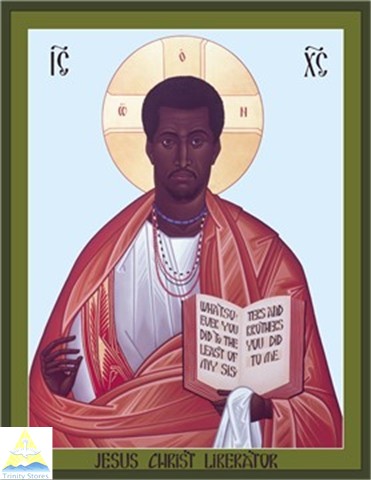
If images of Jesus as a Caucasian are the only images available, they are invalid. However, they are valid if Jesus is also portrayed as an African man (the icon above; ironically, orange is the color of the Masai), a Native American, a Chinese man, a woman... It is a sin to appropriate Jesus to serve our cultural values. It is a sin to portray to people of color that Jesus was White - and in retrospect, it does not make sense. MLK eventually came to deny that Jesus was White (although, he did not say that Jesus was Black). Hopefully, churches in Asia will take the Caucasian images down some day. David Abalos says that in order to deal with sustained oppresion and/or to create lasting and positive change, cultural groups must reclaim four "faces", or aspects of themselves: the personal face, the political face, the historical face, and the sacred face. Lentz' portrayal of Jesus as an African goes to the personal, historical, and sacred faces.
Ironically, Lentz is White (Russian ancestry). Whereas people of color often have their skin lightened when portrayed in religious art, Lentz' icons have their skin darkened, if anything. Furthermore, a lot of the Caucasians in his icons look like they've had their skin darkened as well, or at least gone for a tan. Who knows, maybe Lentz is doing subliminal advertising for a tanning salon.
We believe in the one High God, who out of love created the beautiful world and everything good in it. He created Man and wanted Man to be happy in the world. God loves the world and every nation and tribe on the Earth. We have known this High God in darkness, and now we know Him in the light. God promised in the book of His word, the Bible, that He would save the world and all the nations and tribes.
We believe that God made good His promise by sending His Son, Jesus Christ, a man in the flesh, a Jew by tribe, born poor in a little village, who left His home and was always on safari doing good, curing people by the power of God, teaching about God and man, showing the meaning of religion is love. He was rejected by his people, tortured and nailed hands and feet to a cross, and died. He lay buried in the grave, but the hyenas did not touch him, and on the third day, He rose from the grave. He ascended to the skies. He is the Lord.
We believe that all our sins are forgiven through Him. All who have faith in Him must be sorry for their sins, be baptised in the Holy Spirit of God, live the rules of love and share the bread together in love, to announce the Good News to others until Jesus comes again. We are waiting for Him. He is alive. He lives. This we believe. Amen.
This is the Masai Creed: the Christian faith summarized from the cultural experience of the Masai people of Africa. The creed was written for them by Catholic missionaries around 1960.
At first sight, it's a very nice creed that makes you feel all warm and fuzzy. However, the darkness is just below the surface: the creed was written FOR the Masai, but not BY them. Masai Christians have their experience of Christianity defined for them. I'm originally from Singapore, and Christians here have our experience of Christianity defined for us also, mostly by White, Evangelical, conservative missionaries. On my parents' fridge is a small picture of Jesus, his hands outstretched and palms open, a beatific expression on his face. He has light brown hair and Caucasian features. The thing is, my parents and I are Chinese, as are 80% of Singaporeans. And yet, the only images of Christ we see are Caucasian.
Colonialism goes beyond worshipping a God that doesn't look like you, although that is bad enough. Malcolm X, during the Civil Rights era, castigated Black Christians for worshipping a White God and a White Jesus. He saw it as an example of self-hate. Black girls played with White dolls. Even Martin Luther King Jr initially maintained that Jesus was White.
However, Jesus was not White. He was a dark-skinned Semite. A while ago in Popular Mechanics, a forensic anthropologist reconstructed what Jesus probably looked like. The article is here: http://www.dadsdayoff.net/Jesus-real-face.html
Richard Neave, a retired medical artist from the University of Manchester, acquired some skulls of Jesus' era from near Jerusalem, and reconstructed facial features typical of people from that area in Jesus' time. They used drawings from other archaeological sites to estimate Jesus' skin and eye coloration. Paul, in Corinthians, describes it as disgraceful for a man to have long hair; this makes it likely that Jesus had short hair.
If images of Jesus as a Caucasian are the only images available, they are invalid. However, they are valid if Jesus is also portrayed as an African man (the icon above; ironically, orange is the color of the Masai), a Native American, a Chinese man, a woman... It is a sin to appropriate Jesus to serve our cultural values. It is a sin to portray to people of color that Jesus was White - and in retrospect, it does not make sense. MLK eventually came to deny that Jesus was White (although, he did not say that Jesus was Black). Hopefully, churches in Asia will take the Caucasian images down some day. David Abalos says that in order to deal with sustained oppresion and/or to create lasting and positive change, cultural groups must reclaim four "faces", or aspects of themselves: the personal face, the political face, the historical face, and the sacred face. Lentz' portrayal of Jesus as an African goes to the personal, historical, and sacred faces.
Ironically, Lentz is White (Russian ancestry). Whereas people of color often have their skin lightened when portrayed in religious art, Lentz' icons have their skin darkened, if anything. Furthermore, a lot of the Caucasians in his icons look like they've had their skin darkened as well, or at least gone for a tan. Who knows, maybe Lentz is doing subliminal advertising for a tanning salon.
Subscribe to:
Posts (Atom)