Showing posts with label Martyrs. Show all posts

Monday, September 01, 2008

Disappearance of Silvia Quintela


Silvia Quintela [Photo by Desaparecidos.org]was an Argentine doctor who was disappeared on or after September 1, 1977. According to her Wikipedia article, she was one of the best-known victims of the Dirty War, and there is strong suspicion that Dr. Quintela gave birth in custody and had her child stolen.

Silvia Quintela spent the brief number of years that she served as a physician tending to the indigent of Buenos Aires. Because of that service, she was one of the earliest of those singled out as leftist sympathizers. She was 28 years old and four months pregnant when, on 17 January 1977, she was detained while walking down a road. The same men who seized her later broke into her mother's house, rummaged through her belongings, and told her mother that Quintela had been arrested. With help from Quintela's mother, Abel Madariaga tried to find her, but he soon had to flee the country, ultimately becoming a political refugee in Sweden.

According to witnesses, Silvia Quintela was kept at a military base where she eventually gave birth to a baby boy. The newborn was taken away from her, and she was reportedly transported to a military airfield. Her fate has remained unknown, but detainees sent there were often stripped naked, blindfolded, chained together, and put onboard cargo planes, known as "death flights". The planes would fly out over the Atlantic Ocean at night and groups of prisoners would be pushed out to their deaths.

...

In 1983, after the junta relinquished control of the government, Abel Madariaga returned to Argentina and tried to find out what had happened to Silvia and their child. He began to suspect that Major Norberto Atilio Bianco, a military doctor linked by witnesses to pregnant detainees, had in fact taken Quintela's son himself. Babies delivered at the base were either given up for adoption or given to soldiers' families, and Bianco had an adopted son, Pablo, whose age fit into the timeline. Furthermore, Pablo's birthday, 1 September 1977, matches the reported date Silvia Quintela gave birth.

In 1986, the Abuelas de la Plaza de Mayo went to the school of Bianco's children in order to request a DNA paternity test. However, Bianco immediately escaped to Paraguay [2]. Bianco and his wife Susana Wehrli were extradited to Argentina in 1998, while their children continued to live in Paraguay and refused to recognize any other person as biological parents [2]. Madariaga endeavored to resolve Pablo's paternity through DNA testing, but Pablo has, as of 1998, declined to cooperate.

The Argentine magistrate Roberto Marquevich has indicted the former dictator Jorge Videla on charges of kidnapping concerning this and other cases of "stolen babies" [2][3]. Videla was transferred to the Caseros Prison, where Bianco himself was also detained on charges of kidnapping and forgery of official documents (his wife was also detained in the Ezeiza Prison). [2][4]. In 1999, Bianco was released and succeeded in joining the private clinic Buen Ayre and in being re-admitted by the Buenos Aires Medical Board [5][4].

Apart of Silvia Quintela, Pablo may also be the son of Beatriz Recchia, a friend of Silvia Quintana who was detained in the same period, while pregnant since four months. Since no DNA tests have been made, the case has not been cleared yet [5].

According to the Abuelas de Plaza de Mayo 'www.abuelas.org.ar on May 6, 2008 Atilio Norberto Bianco was detained. He was denounced by the association in December 2006 as the head of the clandestine maternity unit that functioned in the Military Hospital of Campo de Mayo during the last military dictatorship in Argentina.

Bianco was summoned for questioning scheduled for April 1, 2008 by the judge Martner Suares Alberto Araujo, owner of the Federal Court No. 2 San Martner, in Buenos Aires province.


As many of the disappeared were labor activists, Quintela is quite an appropriate saint for Labor Day. Without organized labor, we might well not have the 40 hour week or the weekend. However, laborers and their supporters sometimes paid a heavy price.

Thursday, August 14, 2008

Remembering Jonathan Myrick Daniels


The Episcopal Cafe's Daily Reading commemorate's Jonathan Myrick Daniels, an Episcopal seminiarian who was martyred during the Civil Rights struggle in the US. He's on the right in the photo.

Daily Reading for August 14 • Jonathan Myric Daniels, 1965

As soon as [ESCRU’s executive director, the Rev.] John Morris learned of Daniels’s death, he made arrangements for the body to be flown back to Daniels’s home in Keene, New Hampshire, for burial. In place of a formal eulogy at the funeral service, excerpts from Daniels’s theological writings were read aloud to the mourners gathered at St. James’ Church. In one of those selections, he wrote that he had stopped being afraid of death in Alabama, for he realized that “I had truly been baptized into the Lord’s death and Resurrection, that in the only sense that really matters I am already dead, and my life is hid with Christ in God.”

Stokely Carmichael, the SNCC organizer with whom Daniels had worked most closely in Alabama, was deeply upset by the murder and remarked that Daniels had “lived like Christ.” In tears at the interment following the funeral, Carmichael joined hands with other mourners, who softly sang “We Shall Overcome” beside the grave.

At the same time, memorial services were held in many other churches throughout the country, and the slain seminarian received numerous tributes. Frank Mathews expressed shock at what had happened and offered prayers at St. Paul’s. William Stringfellow, who had been one of Daniels’s mentors, called him “an authentic Christian” who had died simply for doing what the gospel demanded; Judith Upham believed his witness demonstrated that “God requires not extraordinary people, but ordinary people with an extraordinary commitment as channels for His grace-full action in the world.”

From Episcopalians and Race: Civil War to Civil Rights by Gardiner H. Shattuck (The University Press of Kentucky, 2000).

Friday, May 30, 2008

Tribute to Joan of Arc, martyred May 30, 1431


Maid of Orleans, by Orchestral Manoeuvres in the Dark


If Joan of Arc had a heart, would she give it as a gift
To such as me who longs to see, how a legend oughta be

Had dreams to give her heart away, like an orphan along the way
She cared so much, she offered up her body to the grave


From Wikipedia

Maid of Orleans had originally been written by Andy McCluskey on 30th May 1981, the 550th anniversary of Joan of Arc's death. The song is in 6/8 time, giving it a waltz-like style. With only eight lines of text it is almost an instrumental. The main theme is a synthesized bagpipe tune (played on the Mellotron --- consisting of the "female choir" and the "3-Violins" presets). The intro is made of strange noises and was added later:[1]
“ The intro was a problem for radio and we did do edited versions where it was shortened.

The idea came about because we actually had the song recorded but thought the track started oddly and needed something else to announce it's arrival. At the time of A+M we were making a lot of music that was ambient soundscapes. The natural thing was to give the song an intro that set up the feel for the main themes to resolve out of the noises.

It's not meant to "mean" anything specific, just set up a feeling to let the track grow out of the strange noises. I think that it worked well!

BTW.. for the sound anoraks...most of the noises are melotron vocal sounds slowed down/sped up and greatly distorted simply by completely overdriving the old Helios desk in The Manor Studio. Pink noise and snare drum in lots of reverb.

Sunday, April 06, 2008

Martin Luther King Jr. and Oscar Romero: Prophets of Easter


Marty and Oscar are usually saints of Lent, which is a season of fasting, penitence, and reflection.

However, Easter is very early this year. Oscar's feast day falls just after Easter, and Marty's falls today.

Well, I don't know what will happen now. We've got some difficult days ahead. But it doesn't matter with me now. Because I've been to the mountaintop. And I don't mind. Like anybody, I would like to live a long life. Longevity has its place. But I'm not concerned about that now. I just want to do God's will. And He's allowed me to go up to the mountain. And I've looked over. And I've seen the promised land. I may not get there with you. But I want you to know tonight, that we, as a people will get to the promised land. And I'm happy, tonight. I'm not worried about anything. I'm not fearing any man. Mine eyes have seen the glory of the coming of the Lord.

MLK, the day before his assassination

I do not believe in death without resurrection. If they kill me, I will be resurrected in the Salvadoran people.

Oscar Romero

These two were prophets of our time. Both took the side of the poor, and both were killed because of it.

What does it mean to be a prophet of Easter season? It means that God remembers that there is no greater love than to lay down one's life for one's friends. It means that God will make it so that nothing the prophets have sacrificed will be in vain.

Monday, December 10, 2007

Azucena Villaflor, disappeared on or about Dec 10, 1977: Reflection for Advent 2


Advent is about hope and expectation and waiting. The season also has strong ties with eschatology, the part of theology concerned with death, judgment, and the final destiny of the soul and humankind. The term derives from the Greek eskhatos, meaning "last."

December 10 is also International Human Rights Day, the date on which the Universal Declaration of Human Rights was signed in 1948. It was a time when nations were determined that the horrors of WWII would never again occur. The General Assembly said that respect for human rights "is the foundation of freedom, justice and peace in the world."


From Wikipedia:
A forced disappearance occurs when an organization forces a person to vanish from public view, either by murder or by simple sequestration. The victim is first kidnapped, then illegally detained in concentration camps, often tortured, and finally executed and the corpse hidden. In Spanish and Portuguese, "disappeared people" are called desaparecidos, a term which specifically refers to the mostly South American victims of state terrorism during the 1970s and the 1980s, in particular concerning Operation Condor.

According to the Rome Statute of the International Criminal Court, which entered into force on July 1, 2002, when committed as part of a widespread or systematic attack directed against any civilian population, "forced disappearances" qualify as a crime against humanity, which thus cannot be subject to statute of limitation.


In Argentina, the Dirty War, or Guerra Sucia, lasted form 1976 to 1983. It was not a war against an external enemy, or a civil war in the strict sense. The political history of Argentina is complicated and I do not fully understand it. But it is fairly clear that the Dirty War was a state-sponsored campaign of violence against perceived Argentinian "subversives". Here, "subversives" seems to include trade unionists, socialists, communists, and anyone perceived to be affiliated. There is evidence that because of the fear of Communism, the United States assisted or at least condoned the violent acts of the Argentine military in its own and other Latin American countries.

Estimates by human rights groups place the total casualties in the Dirty War at 30,000. A report conducted by Argentine security forces in mid 1978 and later published estimates that up to 22,000 people had been killed or disappeared by that time.

The country later reverted to civilian democratic rule, but the war criminals were able to manipulate the legal system to escape prosecution. Often, when pregnant women were abducted, they were allowed to give birth, and then they were murdered. "Subversives breed subversives," so their children were often given to military families. These things have all left a scar on the Argentine psyche.


On April 30, 1977, Azucena Villaflor and 13 other women, whose names are listed below, started marching on the Plaza de Mayo, in front of the Casa Rosada, the presidential palace. Azucena's son Nestor, and his wife, Raquel Mangin, had been disappeared. They wore white scarves, symbolizing the dove of peace, and these became the mothers' symbol. They also wore rose buds - a white one if they knew their child was alive, a red one for those who were dead. They had asked the Ministry of the Interior, the church, the police, the military, but there was no acknowledgment that their children were even missing. And the not knowing itself was part of the terror.

The Mothers started to know each other while knocking on those doors and one evening in April of 1977, while they were waiting for a priest at the Stella Maris Church, one of them, Azucena Villaflor de Devicenti, said: "If we do this on our own, we will not get anything. Why don't we go to the Plaza de Mayo and when we become a large group, Videla (then president) will have to meet with us ... "Azucena Devicenti chose the Plaza de Mayo as the meeting place because it is located across the street from the Government House (Pink House) and for being a historical and traditional place for demonstrations.
From the Easy Buenos Aires City website.

Azucena Villaflor herself was disappeared on Dec 10, 1977, which was also International Human Rights Day. The Mothers had published a newspaper advertisement with the names of their disappeared children. She was abducted at night by soldiers. She was probably tortured, as were many of the disappeared. Her body was identified in 2005 by the Argentine Forensic Anthropology Team, which was created to locate and identify the bodies of the disappeared. Her skeleton displayed the forensic evidence of a large impact, and she had likely been drugged, bound, and thrown out of an airplane over water, which was a common way of killing someone so that the body could not be found. These flights were known as vuelos de las muerte, or death flights.

Azucena's remains were cremated and buried at the foot of the May Pyramid on the Plaza de Mayo. The Abuelas (Grandmothers) of the Plaza de Mayo continued the mission of the Mothers, establishing a genetic database to help identify children who had been abducted and given to military families (some were adopted internationally in good faith on the adoptive parents' parts). 56 children were located, 7 of whom died. 31 are with their biological parents, and 13 are being raised jointly (the good faith adoptions). Many of the military adoptive parents managed to escape justice.

However, when one of the first parents to be prosecuted said that the child was better off with him, because he had not harmed her and that to remove her would be far more traumatic to her, the Supreme Court of Argentina disagreed. They ruled that the murders, disappearances and abductions were now public. Paula, the child, would soon learn. And besides, she was living with the man who murdered her parents. Mary-Claire King, an American geneticist involved with the Grandmothers and in genetically testing children, details the story of the abductions, the setting up of test procedures, and the fight to prosecute.


I consider human rights to be essential to the complete development of the human race. Those leaders who fail to endorse human rights have something to hide.

However, it's very easy to advocate for human rights from behind a desk - or from a blog. Azucena Villaflor was on the front lines of human rights. She surely knew or suspected that she was placing her life in danger. No one has greater love than this, to lay down one’s life for one’s friends. Azucena stepped out in love and faith for her son and her daughter in law. Right now, human rights are supported by a body of international law in its infancy, by uncertain national laws ... and by hope, and faith, and love.

In this Lentz icon, Mary is dressed as one of the Mothers. The Mothers would hold photographs of their children, and would wear rosebuds: white if they hoped their child was alive, red if they knew their child was dead. As the practice of disappearance spread to other Latin American countries, so did the practice of the Mothers. In this icon, Mary has no photograph of her Son, only His crown of thorns. The white hand print in the bottom left is the blanco mano, the emblem of Salvadoran death squads. Lentz' icon of Oscar Romero is similarly defaced by the presence of military helicopters.

Whenever someone is murdered, or tortured, or left in poverty, or discriminated against, God's image is defaced. But God is found in the faces of those victims of torture and disappearance, and whenever we stand up for human rights, we stand up for God. We Christians cannot stand by when human rights are violated. If Azucena Villaflor had the faith to call her murderous government to account in the Plaza del Mayo, we can have that faith also.


For Azucena Villaflor and the other Mothers of the Plaza del Mayo:

Berta Braverman

Haydée García Buelas

María Adela Gard de Antokoletz

Julia Gard, María Mercedes Gard

Cándida Gard

Delicia González

Pepa Noia

Mirta Baravalle

Kety Neuhaus

Raquel Arcushin

Sra. De Caim

Tuesday, November 27, 2007

Harvey Milk


No one has greater love than this, to lay down one’s life for one’s friends. - John 15:13 (NRSV)

From Robert Lentz:
Harvey Milk was the first openly gay person to be elected to high public office in the U.S. He was not a professional politician, but ran for City Supervisor in San Francisco because he felt ordinary people were being pushed aside there by monied interests. "It takes no money to respect the individual," he said. "The people are more important than words." As supervisor he fought consistently for the rights of all of those without a voice. These people included blue-collar workers, the elderly, racial minorities, and gay men and women.

The day of his election, Harvey tape-recorded his last testament, in which he acknowledged that he would most probably die violently. The last words of that message were "You gotta give them hope."


Do you know what it's like for lesbian, gay, bisexual, and transgender people to have one of their own numbered among the saints?

Harvey Milk is a martyr to the LGBT community, and Harvey Milk School in New York is named after him. He was Jewish, and I'm not aware that he was particularly religious. He's not on the Episcopal Church's calendar of Lesser Feasts and Fasts. However, he's a saint, and I'm going to prove it.

He came to be known as the Mayor of Castro Street; the Castro is a prominent gay neighborhood in San Francisco. It didn't used to be that way, having been Scandinavian from 1910-1920, and then Irish working class from 1930-1960. In 1975, Harvey opened a camera store, and began a life as a gay activist.

"We must destroy the myths once and for all. We must continue to speak out and most importantly every gay person must come out. As difficult as it is, you must tell your family, you must tell your relatives, you must tell your friends, you must tell your neighbors, you must tell the people you work with, you must tell the people in the stores you shop in, and once they realize that we are indeed their children and that we are indeed everywhere, every myth, every lie, every innuendo will be destroyed once and for all. And once you do you will feel so much better."


I find it interesting, by the way, that the LGBT community in the US has co-opted the term "queer" to refer to themselves. "Queer" used to be an insult. Many older LGBT folk - and some of the younger ones - I know are still uncomfortable with it.

In contrast, gays in Asia, specifically Taiwan, Hong Kong, and parts of mainland China, co-opted the term "Tong Zhi". Tong Zhi is Mandarin for "comrade", as in Comrade so-and-so. It is a polite salutation, rather than an insult. If anyone asks to illustrate how Asians think differently from Westerners, I sometimes give this as an example.

However, there's a time and a place for everything. There's a time to fit in. There's also a time to confront.

In Harvey's time, the police, the psychologists, and the priests were the main enemies of the LGBT community. Police made sting operations and arbitrary arrests. Psychologists propagated theories of impaired sexual development. Priests called homosexuality an abomination. Harvey confronted them.

Of course, he did not personally confront them with violence. For the most part, violence against the police would have been a bad idea, although Stonewall, where gays, lesbians and crossdressers fought back against the police at a raid and taunted them. This was before Harvey's time.

Harvey instead confronted his adversaries in the public square, in politics. People said he was mad to run for public office as an "avowed homosexual." He did anyway. Eventually, he became city supervisor of San Francisco. Once there, though, he acted as a comrade as well as a confronter.

"Our cities must not be abandoned. They’re worth fighting for, not just by those who live in them, but by industry, commerce, unions, everyone. What we need is a neighborhood where people can walk to work, raise their kids, enjoy life. That simple."


His time in office was sadly short. Late in 1978, the conservative board member Dan White resigned from his post. He was a vociferous opponent of George Moscone, the liberal mayor. However, he apparently changed his mind, and asked Moscone to reinstate him. Moscone, under pressure from other liberals on the board, refused him.

On November 27, 1978, White came to City Hall and demanded to speak to Moscone. Moscone refused him. White had crawled in through a window to avoid the metal detector, because he was carrying his policeman's service revolver and ten extra rounds. He shot Moscone, and then he went to Harvey's office. He confronted Harvey angrily, and shot him five times.

That night 40,000 people, men and women, old and young, gay and straight, kept candlelight vigil outside City Hall. A recording that Harvey made was played:

"This is to be played only in the event of my death by assassination.

I realize that a person who stands for what I stand for, an activist, a gay activist, becomes a target or a potential target for somebody who is insecure, terrified, afraid, or very disturbed themselves.

Knowing that I could be assassinated at any moment or any time, I feel that it's important that some people know my thoughts.

I stood for more than just a candidate. I have never considered myself a candidate. I have always considered myself part of the movement, part of the candidacy. I wish I had to explain everything I did. Almost everything was done in the eyes of the gay movement."


He also said, "If a bullet should enter my brain, let that bullet destroy every closet door."

"...Gay brothers and sisters,...You must come out. Come out...to your parents...I know that it is hard and will hurt them but think about how they will hurt you in the voting booth! Come out to your relatives...come out to your friends...if indeed they are your friends. Come out to your neighbors...to your fellow workers...to the people who work where you eat and shop...come out only to the people you know, and who know you. Not to anyone else. But once and for all, break down the myths, destroy the lies and distortions. For your sake. For their sake. For the sake of the youngsters who are becoming scared by the votes from Dade to Eugene."


Many LGBT people I know have been colonized by the church in some way. To colonize a country means to come and settle among and establish political control over the indigenous people of an area. To colonize a people means to discredit their worldview and their epistemology (way of knowing things), and to establish a foreign one. Many LGBT people have been colonized by religion.

So, many of them are in the closet to themselves and/or to their religious communities. They put up with abuse to stay in the good graces of a God they think despises them for their sexual orientations or gender identities. Many have left and would rather die than return. Perhaps Harvey was one of the latter.

And yet, I believe Harvey has something to teach Christians about the Resurrection. There's no evidence that he believed in God. And yet, he was not afraid to lay down his life for his friends. He knew he was likely going to be killed at some point - he premeditated his tape recording, just as Dan White arguably premeditated his murder. He went willingly. He was not a Christian, and yet his actions were those of one who believes in the Resurrection. As a universalist Christian, I believe that the Resurrection is for all people, everywhere.

Whether Harvey knew it or not, he was serving Jesus Christ, foreshadowing Christ's actions. Harvey was paving the way for LGBT people to come out in political life. Lentz' icon shows Harvey Milk as a servant of God, paving the way for LGBT people to come out in religious life.

But through Harvey, Jesus is decolonizing the LGBT community. To decolonize a country means to withdraw from a colony, leaving it independent. To decolonize a people means to cease to poison their hearts and minds and souls against themselves. Jesus doesn't set us free from homosexuality. Jesus sets LGBT people and the church free from homophobia and transphobia. Jesus decolonizes, and sometimes he uses servants who do not know Him to do so.

Saturday, November 17, 2007


From Lentz:

In the early morning hours of November 16, 1989, government troops forced their way into the Jesuit residence of the Central American University in San Salvador and brutally murdered six priests and two women. 75,000 others had already been killed in El Salvador’s civil war and while each death was equally tragic, these eight murders immediately took on special symbolic importance. Shot in the head with M16’s at close range, their brains had been blown out of their skulls. It was as if the army had wanted to wipe out the intellectual life of their country, trampling on all that the university and western civilization represented.

The husband of one of the martyrs has turned the yard in which their bodies were found into a rose garden, which is why roses fill the center of this icon. Moving clockwise from the top, the martyrs are Ignacio Martin-Baro, Amando Lopez, Elba Ramos, Ignacio Ellacuria, Segundo Montes, Juan Ramon Moreno, Celina Ramos and Joaquin Lopez y Lopez.

These people were teachers, priests, peacemakers, and innocent women. Their crime was that they took too seriously the Gospel and the democratic constitution of their country -- documents that had become dusty through neglect. Written documents like these that preserve moral ideals soon lose their life if they are not re-animated in each generation by prophets, artists, and holy fools. These martyrs were prophets who paid the ultimate price so that the ideals they cherished would not die.

Monday, June 18, 2007

Bernard Mizeki, murdered June 18, 1896


Almighty and everlasting God, who kindled the flame of your love in the heart of your holy martyr Bernard Mizeki: Grant to us, your humble servants, a like faith and power of love, that we who rejoice in his triumph may profit by his example; through Jesus Christ our Lord, who lives and reigns with you and the Holy Spirit, one God, for ever and ever.


Bernard was born Mamiyeri Mitseka Gwambe in Portugese East Africa, now Mozambique. He moved to Cape Town, now South Africa, to find work. The poverty and drunkeness of the slums he lived in touched him, and he never drank alcohol. Slums, by the way, still exist in South Africa.

Bernard found the Cowley Fathers' mission, and attended their night school. He later converted to Christianity, took on his christian name, and quickly started converting people. He was then sent to Zonnbloem College to train as a catechist, mastering many African and European languages.

He later accompanied the missionary bishop of Shonaland, George William Knight-Bruce. He came to live simply as the Shona people did, discarding the furniture he built, and to translate the Bible and liturgy into the Shona language. Although he opposed some traditional religious customs, Bernard was very attentive to the nuances of Shona Spirit religion. He developed an approach that built on people’s already monotheistic faith in the one God Mwari and on their sensitivity to spirit life at the same time that he forthrightly proclaimed the Christ. He later married Mutwa, a convert, and was well-respected by everyone except the witch doctors.

One of them, it seems, later had him murdered. There was a rebellion in Mashonaland, and missionaries were ordered to leave, but Mutwa was pregnant, and Bernared stayed. On June 18, he was dragged from his hut and fatally stabbed. Mutwa found him. He ordered her to leave, and she ran to get him some food and blankets. She, and others, saw a bright white light, and heard a sound “like many wings of great birds." When she returned, his body had disappeared.

The place of Bernard's death has become a pilgrimage shrine for all Christians, and a great communion service is held in his honor every June 18.

The more prosaic explanation for the miracle of his disappearance is that Mchemwa, the son of the chief, a "troublemaker", and Bernard's likely murderer, likely had returned to hide the body.

Bernard respected the customs of the people. He did not simply come and tell them what to believe. He let them change him, as much as he tried to change them.

Bernard's story also gives us a glimpse into Christianity in the Global South. Bishop John Spong, one of the Episcopal Church's more controversial and abrasive bishops, once condemned African Christians as superstitious. Not to be outdone, I personally have condemned Asian Christians as superstitious as well. However, Christianity in Asia and Africa is not far removed from indigenous religions. Most Christians are recent converts.

In Asia, many young Christians convert while their families are still praying at shrines in the house set up to idols. People will burn joss sticks (a form of incense) in honor of their dead ancestors. People will offer food to their ancestors - as in, real food. For their ancestors to eat, at least in some metaphysical way. Families burn "hell money" at the Hungry Ghosts festival, so that their ancestors have money to spend in the afterlife.

Rationalist Christianity is not too popular in the Global South. Christians are not trying to convert secular humanists. They are trying to convert those who practice tribal religions, or Hindiusm or Islam. To engage with those religions, one doesn't use a rationalist mindset.

I still don't approve of the way my Global South brothers and sisters in Christ do things. I would rather they heed Brian McLaren's words: don't try to "shoe-horn them out of their religion". Don't impose Christianity on indigenous peoples at the expense of their cultures. Bernard Mizeki did no such thing.

Source
Mike Oettle, who writes about a few saints including Bernard, here.

Saturday, June 02, 2007

Martyrdoms of Mary Dyer and Joan of Arc


I've been really busy this week, so I wasn't able to post this on time. However, Wednesday May 30 was the date that Joan of Arc was martyred, and Friday June 1 was the day that Mary Dyer was martyred.

I've already discussed St. Joan, who followed what she believed to be God's orders, against the teachings of the church (especially on the matter of gender roles and appropriate clothing) to her death. History proved her right, and I believe the Episcopal Church now includes her in Lesser Feasts and Fasts.

Mary Dyer was another such woman. Unlike Joan, she was not a soldier, but she is the only woman to die in the US from causes related to religious freedom. From the Wikipedia article:

In 1637 Mary Dyer met Anne Hutchinson, who preached that God "spoke directly to individuals" rather than only through the clergy. Dyer joined with Hutchinson and became involved in what was called the "Antinomian heresy," where they worked to organize groups of women and men to study the Bible in contravention of the theocratic law of the Massachusetts Bay Colony...

Mary Dyer and her husband returned to England with Roger Williams and John Clarke in 1652, where Mary Dyer joined the Religious Society of Friends (Quakers) after hearing the preaching of its founder George Fox and feeling that it was in agreement with the ideas that she and Hutchinson held years earlier. She eventually became a Quaker preacher in her own right.

The Dyers returned to Rhode Island in 1657. The next year she traveled to Boston to protest the new law banning Quakers, and she was arrested and expelled from the colony. (Her husband, who had not become a Quaker, was not arrested.)

Mary Dyer continued to travel in New England to preach Quakerism, and was arrested in 1658 in New Haven, Connecticut. After her release, she returned to Massachusetts to visit two English Quakers, William Robinson and Marmaduke Stephenson, who had been arrested. She was also arrested and then permanently banished from the colony. She traveled to Massachusetts a third time with a group of Quakers to publicly defy the law, and was again arrested, and sentenced to death. After a short trial, two other Quakers were hanged, but because her husband was a friend of Governor John Winthrop he secured a last-minute reprieve -- against her wishes, for she had refused to repent and disavow her Quaker faith.

She was forced to return to Rhode Island, traveled to Long Island, New York to preach, but her conscience led her to return to Massachusetts in 1660 to defy the anti-Quaker law. Despite the pleas of her husband and family, she again refused to repent, and she was again convicted and sentenced to death on May 31. The next day Mary Dyer was hanged on Boston Common for the crime of being a Quaker in Massachusetts.

"Nay, I came to keep bloodguiltiness from you, desireing you to repeal the unrighteous and unjust law made against the innocent servants of the Lord. Nay, man, I am not now to repent."


A statue of her stands outside the Massachusetts State House in Boston.

Given the nature of the times we're in, both conservative and liberal Anglicans could politicize these women, and say that we too must follow God's commands, and to heck with the Nigerians/Americans. Both sides are, after all, pretty darn sure that they're following God's law. But it is not my intent to politicize the witness of these saints.

Mary and Joan were called by God, it seems. Their fellows turned against them, and killed them, and certainly in Joan's case, her gender played some role in her death. Lord, have mercy on us.

Mary's and Joan's witness do show us that sometimes, you have to do what you are called by God to do. Only history may vindicate your actions, so you have to realize that you might be wrong.

Did Mary have doubts, in her heart, as she was led to be hanged? Did she at least consider the possibility that she was wrong? It's impossible for me to say. But if she did, she still acted on what she believed were God's orders, as did Joan. And God vindicated them in time.

So, God, have mercy on those who killed Joan and Mary. Grant Joan and Mary rest eternal, and let light perpetual shine upon them. And God, please grant us all your spirit of discernment. Let it be that no one needs to be imprisoned or persecuted for following you, and let us never think that following you means we are called to imprison or kill our fellow human beings. Because, to you, we are all sisters and brothers. Amen.

Thursday, April 19, 2007

Mayor Iccho Itoh of Nagasaki

By David Krieger, President of the Nuclear Age Peace Foundation
Article dated Apr 18

The Nuclear Age Peace Foundation mourns the death of Nagasaki Mayor Iccho Itoh, whose life was cut short by an assassin’s bullet. With this tragedy, the world has lost a great peace leader. As the three-term mayor of the last city to suffer atomic devastation, he became a leading spokesperson for a world free of nuclear weapons.

Mayor Itoh was the vice president of Mayors for Peace and a leader of their global campaign to eliminate nuclear weapons by the year 2020. The Foundation honored Mayors for Peace and the leadership of Mayor Itoh and Hiroshima Mayor Tadatoshi Akiba with our 2004 World Citizenship Award.

Mayor Itoh played a significant role in the three Nagasaki Global Citizens’ Assemblies held while he was mayor. The most recent of these took place in fall 2006. In his Opening Address to this Assembly, he underscored his deep commitment, and that of the people of his city, that Nagasaki “must be the last place where an atomic bomb is dropped….” He made this a major goal of his life.

Along with many of my colleagues working for the abolition of nuclear weapons, I had the pleasure and honor of knowing Mayor Itoh. He was a man with an easy smile and open manner, but one with a firm dedication to building a lasting peace. In Nagasaki, he was a gracious host to so many of us who participated in the Nagasaki Citizens’ Assemblies.

In tribute to Mayor Itoh, we have included a link below to a reprint of the Nagasaki Peace Declaration, which he delivered on August 9, 2006. I urge you to read it as the final testament and call to action by a great man. Let its words sink into your heart, particularly these words: “The time has come for those nations that rely on the force of nuclear armaments to respectfully heed the voices of peace-loving people, not least the atomic bomb survivors, to strive in good faith for nuclear disarmament and non-proliferation, and to advance towards the complete abolishment of all such weapons.” To achieve this goal will require an active citizenry. Citizens of the nuclear weapons states, and particularly the United States, will have to lead their political leaders.

In closing his speech, he prayed for the undisturbed repose of those who lost their lives in the atomic bombings and proclaimed Nagasaki’s commitment “to continue to strive for the establishment of lasting world peace.” In honoring Mayor Itoh’s life and commitment to a world free of nuclear weapons, let us add our own commitment to this cause so critical to humanity’s future.

Tuesday, April 10, 2007

Dietrich Bonhoeffer, executed April 9, 1945


Icon by Lewis Williams

Gracious God, the Beyond in the midst of our life, who gave grace to your servant Dietrich Bonhoeffer to know and teach the truth as it is in Jesus Christ, and to bear the cost of following him: Grant that we, strengthened by his teaching and example, may receive your word and embrace its call with an undivided heart; through Jesus Christ our Savior, who lives and reigns with you and the Holy Spirit, one God, for ever and ever.

Bonhoeffer was a German Lutheran pastor and theologian who participated in the German resistance to Nazism, and who was involved in a plot to kill Hitler with his brother and brothers in law. The plot failed. They were arrested, and hanged on April 9, 1945.

By gracious powers so wonderfully sheltered,
and confidently waiting come what may,
we know that God is with us night and morning,
and never fails to greet us each new day.

Yet is this heart by its old foe tormented,
still evil days bring burdens hard to bear;
Oh, give our frightened souls the sure salvation
for which, O Lord, You taught us to prepare.

And when this cup You give is filled to brimming
with bitter suffering, hard to understand,
we take it thankfully and without trembling,
out of so good and so beloved a hand.

Yet when again in this same world You give us
the joy we had, the brightness of Your Sun,
we shall remember all the days we lived through,
and our whole life shall then be Yours alone.
--Dietrich Bonhoeffer

Wednesday, April 04, 2007

Martin Luther King Jr, assasinated March 4, 1968


Martin Luther King Jr was assasinated this day, 1968. He is only one of three Americans to have a holiday named after them. The other two are Presidents, which indicates that King's achievements in racial reconciliation and nonviolent resistance to evil were truly extraordinary.

Of course, America was not always so hot about King. The FBI started wiretapping his phones in 1961, looking for evidence of Communist influence in the Civil Rights movement. They found none, and accused him of having affairs, instead, a charge which unfortunately seems to be true. And, of course, racists threatened him with violence or death.

The icon, by Robert Lentz, depicts King in jail. The inscription he holds reads, "How long will justice be crucified and truth buried?", which is from his speech in Albany, Georgia in 1961. When he was in one such jail, a number of White clergy wrote to him, counselling moderation and obedience to the law. They called his protest activities "unwise and untimely." To my shame, the list includes the then Episcopal Bishop and Bishop co-adjutor of Alabama, CCJ Carpenter and George Murray, respectively.

Martin Luther King told them very nicely that they had no idea what they were talking about, no idea what African-Americans had been going through. He said that the laws were unjust, and that they needed to be protested. And he warned that if Whites continued to dismiss him and his followers as "rabble-rousers", that African-Americans would take to violence.

As it turns out, America was de-segregated without large-scale violence. But the economic disadvantages that had accrued over decades persisted. King, once again, went to bat for his people. America, once again, resisted. Martin accused Congress of demonstrating "hostility to the poor," of "military funds with alacrity and generosity," but "poverty funds with miserliness." America accused him, incorrectly this time, of Communism.

Today, our priorities are still wrong, with the last Congress passing tax cuts for the rich and cutting social programs. Income and wealth disparities between African-Americans and Whites still exist. Wealth, being income that is accumulated over generations and passed down, is the bigger problem.

Martin's job, then, isn't complete. We draw icons of our saints and put halos around their heads, but they are still human. Ending injustice is not a human task. As James Cone, a renowned Black liberation theologian says,

"King's emphasis on the eschatological hope of freedom as defined by "the coming of the Lord" was not derived from white theologians and philosophers, but from his own religious tradition. These words of faith and hope were derived from the black tradition as defined by our pain and suffering. People who have not lived in the context of hundreds of years of slavery and suffering are not likely to express an eschatological hope of freedom. Hope in God's coming eschatological freedom is always derived from the suffering of people who are seeking to establish freedom on earth but have failed to achieve it. In their failure to establish freedom in their existing present, black people prevented despair from becoming the defining characteristic of their lives by looking forward to God's coming, eschatological freedom."

And so, this post starts with an icon of and a story about Martin. But, it ends with an icon of Jesus Christ, Liberator, by Robert Lentz. Here, Jesus is an African man, dressed in African colors: burnt orange for the Masai, white for the peoples of the Sahara. Human effort is good and I will give my best, but ultimately, I put my trust in Jesus Christ.

Wednesday, February 21, 2007

Malcolm X: assasinated Feb 21, 1965


"Never have I witnessed such sincere hospitality and the overwhelming spirit of true brotherhood as is practiced by people of all colors and races here in this ancient Holy Land, the House of Abraham, Muhammad, and all the other Prophets of the Holy Scriptures. For the past week, I have been utterly speechless and spellbound by the graciousness I see displayed all around me by people of all colors. . . .
You may be shocked by these words coming from me. But on this pilgrimage, what I have seen, and experienced, has forced me to rearrange much of my thought-patterns previously held, and to toss aside some of my previous conclusions. This was not too difficult for me. Despite my firm convictions, I have always been a man who tries to face facts, and to accept the reality of life as new experience and new knowledge unfolds it. I have always kept an open mind, which necessary to the flexibility that must go hand in hand with every form of intelligent search for truth.

During the past eleven days here in the Muslim world, I have eaten from the same plate, drunk from the same glass, and slept in the same bed (or on the same rug) -- while praying to the same God -- with fellow Muslims, whose eyes were the bluest of blue, whose hair was the blondest of blond, and whose skin was the whitest of white. And in the words and in the actions and in the deeds of the "white" Muslims, I felt the same sincerity that I felt among the black African Muslims of Nigeria, Sudan, and Ghana.

We were truly all the same (brothers) -- because their belief in one God had removed the "white" from their minds, the 'white' from their behavior, and the 'white' from their attitude.

I could see from this, that perhaps if white Americans could accept the Oneness of God, then perhaps, too, they could accept in reality the Oneness of Man -- and cease to measure, and hinder, and harm others in terms of their "differences" in color.

With racism plaguing America like an incurable cancer, the so-called "Christian" white American heart should be more receptive to a proven solution to such a destructive problem. Perhaps it could be in time to save America from imminent disaster -- the same destruction brought upon Germany by racism that eventually destroyed the Germans themselves.

They asked me what about the Hajj had impressed me the most. . . . I said, "The brotherhood! The people of all races, color, from all over the world coming to gether as one! It has proved to me the power of the One God. . . . All ate as one, and slept as one. Everything about the pilgrimage atmosphere accented the Oneness of Man under One God."

Friday, February 16, 2007

Janani Luwum, murdered Feb 17


O God, whose Son the Good Shepherd laid down his life for the sheep: We give you thanks for your faithful shepherd, Janani Luwum, who after his Savior’s example gave up his life for the people of Uganda. Grant us to be so inspired by his witness that we make no peace with oppression, but live as those who are sealed with the cross of Christ, who died and rose again, and now lives and reigns with you and the Holy Spirit, one God, for ever and ever. Amen.


Janini Luwum was the Anglican Archbishop of Uganda from 1974-77. This was during the time of Idi Amin's regime. Amin was a brutal, power-hungry dictator, and a murdered. The Langi and the Acholi were victims of state-inspired violence during his reign; Milton Obote, the Prime Minister of Uganda whom Amin deposed in a coup, was Lango, and Luwum was Acholi. The Asian population suffered violence from the military, and in 1972 they were expelled from Nigeria.

Luwum was elected archbishop in 1974, and allowed Amin to cultivate a relationship with him. Amin was likely seeking credibility. Luwum tried to moderate Amin's excesses.

But Amin was not a man whose excesses could be moderated. The Anglican and Roman Catholic churches increasingly worked together to try to respond to him, and Uganda's Muslims joined them.

“While the opportunity is there, I preach the gospel with all my might. My conscience is clear before God that I have not sided with the present government (Amin’s), which is utterly self-seeking. I have been threatened many times. Whenever I have the opportunity, I have told the president the things the church disapproves of. God is my witness.”

Luwum delievered a letter to Amin on February 12, 1977, protesting the security forces' use of disappearances and arbitrary killings. (Disappear: (of a person) go missing or (in coded political language) be killed). Amin arrested Luwum and two Cabinet ministers, Erinayo Wilson Oryema and Charles Oboth Ofumbi, on fabricated charges of planning a coup. They were tortured and shot to death. Some say that Amin personally shot Luwum.

Amin escaped justice, going into exile in Saudi Arabia. Luwum is commemorated as a martyr in the Church of England and in the Episcopal Church, and his statue is part of a gallery of ten 20th century martyrs at Westminster Abbey in London. Sadly, I didn't know of Luwum when I was in London this summer, so I didn't manage to get a picture of his statue. The picture here is from Westminster Abbey's own site.

http://www.westminster-abbey.org/tour/martyrs/3_jl.htm

Saturday, December 02, 2006


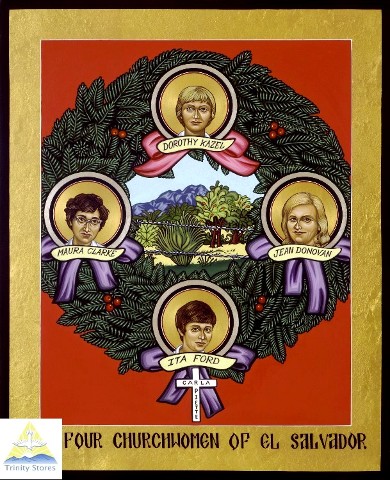
Four Church Women of El Salvador, and a Condemnation of Sexual Violence

This is in memory of
Sisters Ita Ford and Maura Clarke of Maryknoll
Jean Donovan
Sister Dorothy Kazel, Ursuline Sisters of Cleveland
(The icon is by Anthony Lewis and it's available from Trinity Stores at the link below)
Murdered Dec 2, 1980

And all the victims of rape and other forms of sexual violence, male and female ... some of whom are my friends


Around the time of the Salvadoran civil war, these four women, and other Americans, served as missionaries in El Salvador. Dorothy, for example, taught Salvadorans how to read and write with a program known as CARITAS (caritas means charity in Latin), and empowered them to teach their fellow Salvadorans. The war started in 1977, and Dorothy found she couldn't leave. She worked with refugees, and with mothers who had lost their children. Dorothy said, "I could not leave Salvador, especially now ... I am committed to the persecuted Church here." She and her sisters found that they had to live out God's preferential option for the poor, no matter what it might cost.

On the night of December 2, Dorothy and Jean Donovan went to the airport to pick their fellow missioners up. Ita Ford and Maura Clarke were returning from a Maryknoll sisters in Nicaragua. Five members of the Salvadoran National Guard intercepted them outside of the airport. They were taken to an isolated spot, and were raped and shot at close range. Their naked bodies were found buried in a shallow grave the next morning.

Rape as a weapon of war is only one form of sexual violence. In male-female rape, most rapists are known to their victims. Sexual violence may arise in a married relationship, or in an ordinary dating relationship. It may arise in a casual sexual encounter, where ability to consent is impaired by drunkenness. These latter forms of sexual violence are more common than stranger rapes, and more common than rape in war. They are no less a violation of human dignity.

And men are raped very often in prison. Transgender inmates in male prisons are almost certain to be raped. And shame regarding perceived homosexuality may contribute to underreporting, and many human rights groups allege that prison officials tolerate it because it is used to keep the prison population in line. The rape is one violation of human dignity, and our shame and failure to confront it is another - the same goes for not confronting men raping women.

I previously mentioned on this blog that liberal Christians need a sense of sexual ethics. One facet of those ethics must be that we strongly condemn all forms of sexual violence. In fact, Christians of all stripes ought to condemn sexual violence. And yet, it seems we haven't spoken out enough. Andrew Greeley, writing in the Chicago Sun Times, asks why the Catholic Church has remained silent on the topic of violence against women, despite condemning all sorts of "sins of the flesh" and "sins against life."

Greeley also points out that too many men - including some clergy - need to boss women around to affirm their masculinity. Such men are cowards. Their attitude contributes to a culture which denigrates women, and makes it more acceptable to coerce them. If you are truly brave, you won't be threatened by a woman who is your equal.

Conservative Christians would have us restrict sex to married relationships. For some people, because of their personal and cultural beliefs, it is the right thing to do. It is a choice that liberals ought to respect. However, it will not end violence against women, and it will not end prison rape. Violence against women does not necessarily have to involve forced or coerced sexual intercourse. It can include things such as the actions of the legislature in South Dakota - they completely banned abortion in the state, without exception, and they were using women as a tool for political gain. To my mind, that is an act of violence no less than rape.

We also have to take a good, hard look at the ugly parts of our Scriptures. Some Christians accept their Scriptures as completely infallible - that every word and every passage is completely free from error. There's no easy way to say this - ths is a completely idiotic notion. Many others believe in Biblical inerrancy, which is a limited form in Biblical infallibility - the Bible is correct on issues of faith and practice. This can still be dangerous, because it can still allow rigid interpretations depending on which passages you define as issues of faith or practice. Let's look at the story of Lot, which I have previously mentioned on this blog.

Lot is the only righteous man in Sodom. Male angels come from God to visit him. All the men in Sodom gather outside his house and pound on his door. They want to have sex with the angels - to rape them. Lot refuses - the angels, as guests, are under his protection. He offers to let the city rape his two daughters, who are still virgins. The angels spirit Lot away, and God burns the city to ashes.

99.9% of us would say that God does not condemn violence against women. And yet, Lot put his daughters in grave danger, and faces no punishment. What is going on? If I were God, and I were into the use of fire, there is no way he would have escaped with less than second-degree burns. In fact, in Judges 19, the same thing happens to a Levite and his concubine, only this time, he lets the men of Bethlehem Judah gang-rape the concubine, who dies the next morning. He isn't punished either. And there are other verses in the Bible where rape is treated lightly.

The Bible is a narrative. It is a story about humankind's dynamic response to God. It is the result of a bunch of men (and I don't mean men in the universal sense) coming to know God more and more. It is imperfect, because those men were imperfect. I once heard a story where an Episcopal priest took a Bible, threw it on the ground and stamped his foot on it. He said, "This is just leather, paper, and ink. The word of God is in our hearts, and our minds, and our actions."

I'm not saying to disregard the whole Bible. I'm saying that if you blindly affirm everything in it, you allow others to fall back on it for less savory purposes. When Malcolm X confronted Elijah Muhammad over the latter's shameless infidelity, Muhammad fell back on Biblican figures like David to justify himself. X saw right through Muhammad's flimsy excuses, and eventually they broke their relationship.

If you believe, as I do, that the word of God is in our hearts and minds and actions, then join me in condeming all forms of sexual and relationship violence, and in praying for all victims of such violence, especially Ita, Maura, Jean and Dorothy, killed this day 26 years ago. And let us always oppose all aspects of culture that denigrate women or stand in the way of their equality. Let us in fact take a page from the relationships of same-sex couples, where egalitarianism is often more present.

Amen.


Link to the icon and a brief blurb at Trinity Stores
http://www.trinitystores.com/?detail=617&artist=11
http://www.trinitystores.com/main.php4?&detail=617&artist=11&more=1

Brief bio of Sr Dorothy Kazel
http://www.ursulinesisters.org/dorothy1.htm

Andrew Greeley's article in Chicago Sun Times
http://www.ncdsv.org/images/ChurchNotSpeakingUpforWomen.pdf